





How to use sandbags to prevent flooding the right way.
A sandbag structure does not guarantee a water-tight seal, but properly filled and constructed it can act as a barrier to divert moving water around, instead of through buildings.
Sandbag sacks are usually made of burlap (hessian) or woven polypropylene and typically measure around 35 cm (14 in.) by 66 cm (26 in.). Never use garbage bags (they are too slick to stack) and avoid animal feed sacks as they are too large to handle.
Building an effective sandbag wall is labour-intensive. It takes at least two people to fill a sandbag, and then each 15-20 kg (33-44 lbs) bag needs to be placed in a structure. Six sandbags will protect a standard door opening, but to build a 1.2 meter (4 ft) high pyramid, 3 meters (10 ft) wide, would require about 80 bags weighing up to 1,600 kg (3,527 lbs).
It’s a lot of work, but it has an added intangible benefit. The construction process brings people together and strengthens community spirit at a time when it’s needed most.
How to fill a Sandbag:
Filling sandbags requires two people wearing gloves, steel toecap footwear and if the sand is dry, safety glasses.
One person should place the empty bag between or slightly in front of widespread feet with knees slightly flexed. Fold the throat of the bag to form a collar to enable the other person to empty a rounded shovel of sand.
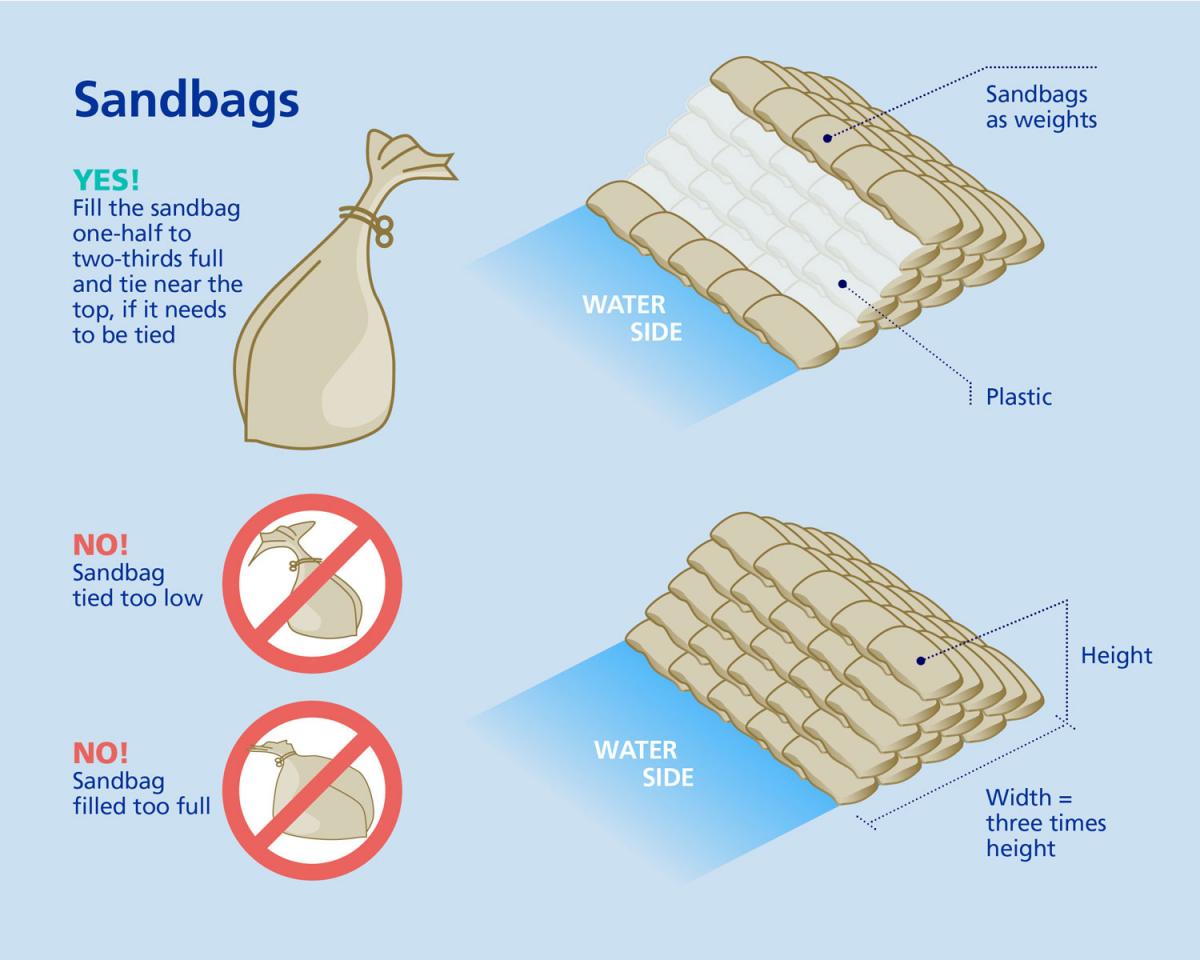
Don’t overfill the bag. This will make it difficult to carry, compact and form a sealed structure. Bags should be filled to one-half to two-thirds of their capacity.
Untied sandbags are easier to stack. Fold over the top flap of the bag, leaving room for the sand to move around and seal the wall. Only tie bags if you plan to transport them, tie them close to the top of the bag to allow for the sifting of the sand.
How to build a Sandbag Wall:
Clear debris from the area where you want to build the wall. Don’t build on uneven ground as sandbags need to settle flat.
Place the sandbags lengthways/parallel to the direction of the water flow. Ensure the open end of the bag is folded under the filled portion of the bag.
Flatten down each row of bags with your foot to eliminate gaps, create a tight seal and support the structure of the wall. Lay the rows like brickwork with each bag overlapping the one below by half.
Build the wall in a pyramid shape when there are four or more rows – it should be three times wider than it is tall.
For added protection, seal the wall with plastic sheeting on the ‘wet’ side secured with a row of sandbags across the top and along the bottom edge.

Scam Alert: Fake information regarding December Bonuses from MSD
The Ministry of Social Development is reporting that fake information is circulating about new ‘December bonuses’ or ‘benefit increases’
If you get suspicious communication, please contact Netsafe.

Poll: Are Kiwis allergic to “exuberance”? 🥝
In The Post’s opinion piece on the developments set to open across Aotearoa in 2026, John Coop suggests that, as a nation, we’re “allergic to exuberance.”
We want to know: Are we really allergic to showing our excitement?
Is it time to lean into a more optimistic view of the place we call home? As big projects take shape and new opportunities emerge, perhaps it’s worth asking whether a little more confidence (and enthusiasm!) could do us some good.

-
41.5% Yes
-
33.6% Maybe?
-
24.9% No

Some Choice News!
Many New Zealand gardens aren’t seeing as many monarch butterflies fluttering around their swan plants and flower beds these days — the hungry Asian paper wasp has been taking its toll.
Thanks to people like Alan Baldick, who’s made it his mission to protect the monarch, his neighbours still get to enjoy these beautiful butterflies in their own backyards.
Thinking about planting something to invite more butterflies, bees, and birds into your garden?
Thanks for your mahi, Alan! We hope this brings a smile!

 Loading…