







The people working for $10 - and less - an hour
New Zealand needs to rethink how the welfare system interacts with tax - and how we approach "punishing" people who are on the benefit, a prominent economist says.
Ganesh Ahirao said the marginal tax rates that people were earning when they shifted off income support, or took on more work at middle incomes, were much higher than those paid by higher-income people.
He looked at a number of household scenarios to illustrate the point and said even with living wage employment opportunities available, people were only earning between $8.78 and $10.65 an hour for additional hours worked. Someone on a minimum wage would earn even less.
The Living Wage is currently set at $27.80 per hour.
=========================================
In one case, a single person whom he referred to as Manaia, with no children, no student loan and paying rent of $415 a week for a one-bedroom flat in Wellington would receive the Jobseeker Support (JS) payment alongside Winter Energy Payment (WEP) and Accommodation Supplement (ASUP) totalling in the hand $592 per week.
Six hours' work at the living wage would take income to just over $700 with those supports.
"But thereafter, the reduction of JobSeeker - at the gut-punching rate of 70 cents for every extra dollar earned - slows in-the-hand increases to a snail's pace. Consequently, the effective marginal tax rate (EMTR) faced by Manaia soars into 80 percent-plus stratospheric territory," Ahirao said.
In another case, a sole parent of two children paying $600 a week would receive the Sole Parent (SP) payment alongside WEP, the Family Tax Credit (FTC) component of Working for Families, and ASUP totalling $1047 per week.
With six hours work at the living wage, the person's income would rise to nearly $1200.
"But then the reductions in support payments brutally cut in. Firstly, the SP declines by 30 cents for every extra dollar earned and then after 10 hours per week by 70 cents per extra dollar earned. The resulting EMTR of 89.2 percent is pushed to 93.3 percent (after 14 hours per week) as FTC payments begin to decline at 27 cents for every dollar of other income. Another hit (at 24 hours per week) pushes the EMTR to 95 percent, as the ASUP also begins to decline (25 cents for every dollar of other income)," Ahirao said.
If the person worked 40 hours a week they would receive $352 more than if they did not work at all.
Ahirao said the tax and welfare systems needed to work together.
"MSD does benefits and IRD does Working for Families and student loans… they have this separation there that needs opt brought together.
"Abatement rates in the welfare system are not seen by the tax system. That's one element.
"We also need to think seriously about our perspective on penalising people. It's a punitive-first approach welfare system. There is a belief out there that everyone should work, should be able to go to work and should take up work whenever they can. To a degree that's ok but then it goes to those who don't work are somehow at fault and should be penalised. That is the perspective to get past."
He said many people out of work were not jobless by choice.
There was little encouragement to work when the benefit was clawed back so quickly, he said. "You take away 70c in the dollar - there's a perspective that if we add on to their part-time income with jobseeker they're going to get too much, it's going to be too generous so we've got to claw it back… do we want to encourage people into the workforce or penalise people for not being in the workforce?
"That's the mindset we need to get over before setting any other policies. That's a big shift in our thinking across the whole political spectrum."
A universal basic income could be part of the conversation, he said.
"I'm comfortable saying you have aright to an adequate income and that involves an obligation to contribute in society, make yourself available for work. You don't go from there to we're going to bash you with a whole lot of sanctions. You tweak the settings to make it as attractive as possible to contribute. A carrot rather than a stick approach."
Ministry of Social Development general manager of welfare system and income support Fiona Carter-Giddings said the ministry's priority was getting people into work.
"Between June 2024 and June 2025, 86,000 benefits were cancelled because the person found a job.
"We're pleased New Zealanders continue to move off benefit and into work, despite challenging economic circumstances. When people are employed they have a higher income and more opportunities to improve their quality of life.
"Government financial assistance generally reduces as other income increases, because New Zealand's welfare system targets support to people who need it the most. This is a long-standing principle of social security.
"The ideal rate at which support should reduce involves trade-offs between income adequacy, incentives to work, and maintaining appropriate costs to the taxpayer. The welfare system is designed to balance these objectives, and it is an area of ongoing debate."
====================================================

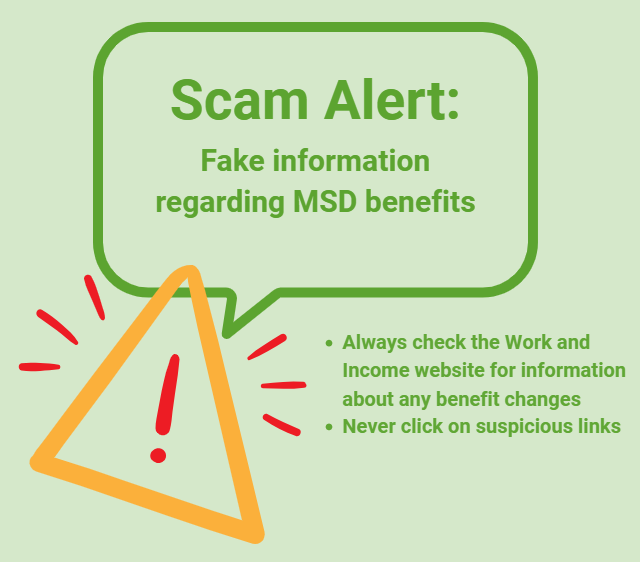
Scam Alert: Fake information regarding December Bonuses from MSD
The Ministry of Social Development is reporting that fake information is circulating about new ‘December bonuses’ or ‘benefit increases’
If you get suspicious communication, please contact Netsafe.
Poll: Are Kiwis allergic to “exuberance”? 🥝
In The Post’s opinion piece on the developments set to open across Aotearoa in 2026, John Coop suggests that, as a nation, we’re “allergic to exuberance.”
We want to know: Are we really allergic to showing our excitement?
Is it time to lean into a more optimistic view of the place we call home? As big projects take shape and new opportunities emerge, perhaps it’s worth asking whether a little more confidence (and enthusiasm!) could do us some good.

-
41.5% Yes
-
33.6% Maybe?
-
24.9% No
Tips and advice to stay street smart this summer
Summer is finally here!
Time for BBQs, holidays, Christmas, travelling and events galore.
We've put together a whole range of tips and advice so you can put your feet up and relax this summer, knowing that it's all good in your hood.
Our first piece of advice to make your neighbourhood safer this summer, is to get to know the people who live around you! People who know each other are more likely to offer, accept, and ask for help when needed.
Shop Safe - Preventing Fraud & Scams
You might find yourself making more purchases than usual at this time of year, and many of those might be online, so here's a set of tips and advice to make sure you stay safe and secure whilst doing your Christmas shopping this year. And remember to think about the security of your online shopping when it gets delivered!
Heading away this summer?
It's a busy time of year on new Zealand roads and everyone wants to get from A to B safely. It's also important that your home stays safe while you're away enjoying your 'home away from home'. We have put together a set of tips and advice to help make that happen!
Keeping your car, home and belongings safe
From recording valuable possessions to securing locks, keeping valuables hidden and informing trusted neighbours that you will be away, there are many things you can do to keep your car, home, and belongings safe. Here's a bunch of handy tips!
Party planning checklist and fire-wise tips
Whether it’s a small backyard gathering, or a big celebration for a special occasion, a little extra planning and consideration will go a long way in keeping you, your guests, and your neighbours happy. We also have some tips to make sure you and your families stay fire-wise during summer.
Get to know your neighbours - look out, reach out, help out
The most important action you can take to make your community safer is get to know the people who live around you. People who know each other are more likely to offer, accept, and ask for help when needed.
It is also important to know who to contact in an emergency and when to use the non-emergency contact for NZ Police. Learn more about Neighbourhood Support, get tips on getting to know your neighbours and the best way to contact the police below.
Strong communities start with small hellos
In terms of crime prevention, your neighbours are the best and cheapest security system you can have. You don't have to love your neighbour, but at least get their number just in case!
===================================
Have a happy, safe and connected summer!
===================================
 Loading…