





Platelet-rich plasma (PRP)
Platelet-rich plasma (PRP)
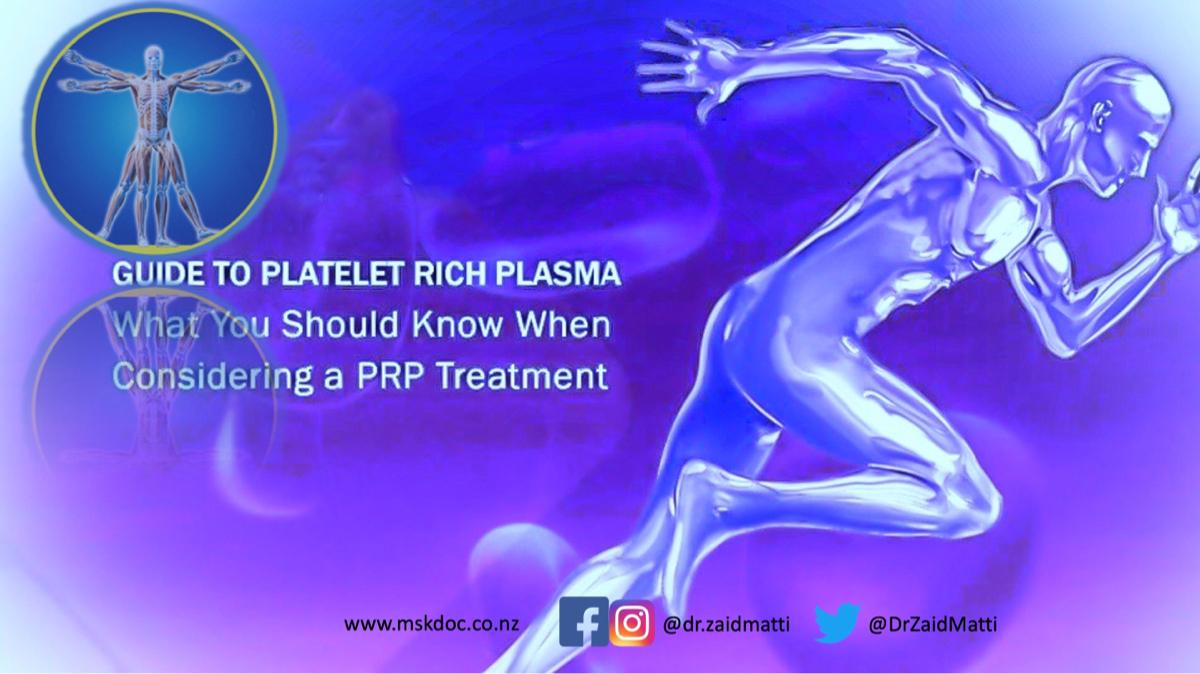
Platelet-rich plasma injections promote and accelerate the healing process providing significant improvement in the treatment of musculoskeletal injuries.
Platelets are small, colourless, disk-shaped cell fragments lacking a nucleus that is found in blood and play an imperative role in clot formation. They also have antimicrobial properties that support healing, infection control and the release of growth factors. These growth factors orchestrate the vital biological processes required for healing. Most importantly, as it relates to healing, platelets also release numerous growth factors, including PDGF, TGF-β, VEGF, and SDF-1α, that have been shown to orchestrate the key biological processes, including angiogenesis, inflammation resolution and tissue regeneration.
Growth factors are necessary to initiate tissue repair at a wound site. Growth factors derived from platelets are responsible for soft tissue repair, bone regeneration, development of new blood vessels and stimulation of the wound healing process. The concentrated platelets we use may help optimise the conditions for healing.
Plasma is the fluid component of blood that contains water, vital proteins, salts, minerals, sugars, fats, hormones and vitamins. Recently, plasma has been found to carry beneficial anti-inflammatory proteins such as Interleukin-1 Receptor Antagonist and Alpha-2-Macroglobulin. These proteins are known to “shut off” mechanisms that lead to degeneration and catabolic inflammation in the body.
The concept behind the clinical use of these blood components is to harness the natural biological ability of a patient’s blood―primarily platelets―which may help optimise the conditions for healing, improve inflammatory response, control infection and promote angiogenesis.
Platelets facilitate healing through the release of many growth factors actively involved in this process. Thus, PRP offers the physician an alternative to popular treatments, such as steroid injections. Such treatments provide short-term relief by masking symptoms such as pain and inflammation that are the result of an injury, rather than addressing the cause of the injury directly through the repair of damaged tissue.
Stem cells are at the core of the tissue regeneration process. They are required to rebuild and repair damaged tissue at an injury site. Platelets release several growth factors, such as SDF-1α, that function to induce migration of stem cells to the damaged tissue during the healing process. PRP provides these growth factors in high concentrations.
The PRP procedure is considered a safe treatment.
A small amount of the patient’s blood is taken, just as a blood test would be performed. The blood is then spun in a centrifuge to separate and concentrate the platelets. We then analyse the PRP solution to make sure our patients are receiving the appropriate cellular concentration and cellular counts for their condition. This plasma highly concentrated with platelets, and other cells are then injected into the site of injury or tissue degeneration under ultrasound guidance with precise, advanced, minimally invasive techniques.
Dr. Matti believes each patient and injury is different. We do not support the use of PRP as a “one size fits all” treatment. This is because PRP utilises your own blood, and this means there are variations between patients. We can individualise PRP treatments depending on the patient and the conditions we are treating. We incorporate ultrasound guidance to inject PRP to the affected areas accurately.
Indications for PRP Injections
Osteoarthritis, usually mild to moderate forms.
Refractory tendinosis, Examples:
– tennis elbow (lateral epicondylitis)
– golfers elbow (medial epicondylitis)
– patellar tendinosis
– Achilles tendinitis
-Plantar fasciitis
-Shoulder pain due and Rotator cuff tears
After Care
PRP injections are designed to use platelets to trick your body into thinking that the affected area is injured, therefore triggering a regenerative response from your body. NSAID are hence stopped for 48 hours after the procedure.
Can be painful for up to 1 week, therefore often need regular pain relief.
Rest, ice and elevate limb for 48 hours.
Initially cease all activities for the first week but can resume normal day to day activities.
In the second week, can resume light exercises and progressively build back to normal exercise after 4 weeks.
Most patients see the most benefit, approximately 4-6 weeks post-injection.
PRPPlatelet-rich plasma (PRP)

Poll: Do you set New Year’s resolutions?
🎉 2026 is almost here!
We’re curious ... how do you welcome it?
Do you set resolutions, follow special traditions, or just go with the flow?

-
10.2% Yes! New Year, New Me
-
20.3% Yes - but I rarely stick to them
-
69.5% Nah - not for me

Witnesses sought in relation to mass disorder on K-Road Auckland
Police are appealing to the public for any footage they may have of the mass disorder that occurred on Karangahape Road in Auckland in the early hours of Sunday 28 December.
Emergency services were called to the disorder around 3.41am where it is estimated around over 50 people were present.
A Police investigation is underway after there were three serious assaults on and around Karangahape Road during the mass disorder.
A portal has been set up to allow the public to upload any footage they have of the disorder and the serious assaults.
The portal is https://dahr.nc3.govt.nz/
Police have arrested one person but are asking for help to identify and locate others involved.
• Around 4:15am there was a serious assault outside the Crown Bar on Queen Street.
A 33-year-old man received serious injuries and was hospitalised.
The offender is still unknown, and the Police file number is 251228/4647.
• Around 4:30am there was another serious assault on a Cobden Steet just off Karangahape Road.
A 27-year-old man received serious injuries and was hospitalised.
The offender is still unknown, and the Police file number is 251228/4462.
• Around 5am there was third serious assault at the Mobil Service Station on the corner or Karangahape Road and Ponsonby Road.
A 46-year-old man received serious injuries and was hospitalised.
A 21-year-old man has been charged with wounding with intent to cause grievous bodily harm.
He has been bailed to appear in court again on 16 January 2026.
The Police file number is 251228/4774.
Police would like to speak to anyone who has witnessed or filmed the assaults.
Witnesses can call Police directly on 105.
Please quote one of the above file numbers.
Scam Alert: Fake information regarding December Bonuses from MSD
The Ministry of Social Development is reporting that fake information is circulating about new ‘December bonuses’ or ‘benefit increases’
If you get suspicious communication, please contact Netsafe.

 Loading…