





Changing Your Customer’s Opinions
The former managing director for Facebook Australia & New Zealand has some very strong opinions about how social media and modern communication technology is changing the way people form their opinions.
The question is are you up to speed with how your customers form opinions about your brand?
Stephen Scheeler, the former managing director of Facebook Australia and New Zealand, points out that “we have entered an era where technology in good and not so good ways is impacting how humans do lots of different things and one is how they form opinions."
Stephen has concerns about how rapidly technology has transformed the way people build and change their opinions. He feels strongly that the accelerated changes are so great that even an insider with his experience cannot fully understand what is happening.
And although he is specifically referring to the way social media may have influenced the recent Australian elections, these concerns hold true for understanding your consumers and how they form opinions about your brand. What does this mean for your organisation?
The first thing to realise is that you can’t leave your head in the sand. The advertising world is rapidly changing and you need to get onboard with that. If you think that your advertising approach from even 5 years ago is up to date then you need to revisit the way you market your brand.
Targeted advertising is taking a larger share of audience than ever before so you need to know who your audience is in much greater segmentation detail than ever before. You can no longer assume the average grocery buyer is a mum with two children for example.
You also need to know how your consumer interacts and communicates with their community. As Ariadne Vromen, professor of political sociology at the University of Sydney, points out, social media “can be used to shore up your base, delivering messages to them as you know other forms of traditional advertising aren’t working”.
Ariadne adds that it isn’t only the young but older people who are using Facebook to verify opinions and establish trust in products and organisations. Social media is a powerful tool that has transformed the way your customers modify their opinions and you need to ensure you’re using it appropriately for your customer base.
Finally, you, as a business owner, need to invest more in your data collection and analysis tools. Build an expert marketing team and create an holistic approach to your advertising that talks to your consumers where and when they’re listening.


Today’s Mind-Bender is the Last of the Year! Can You Guess It Before Everyone Else? 🌟🎁🌲
I dance in the sky with green and gold, a spectacle few are lucky to behold; I’m best seen in the south, a celestial sight—what am I, lighting up the New Zealand night?
Do you think you know the answer? Simply 'Like' this post and we'll post the answer in the comments below at 2pm on the day!
Want to stop seeing these in your newsfeed? No worries! Simply head here and click once on the Following button.

Scamwatch: How to recognise, avoid and act against scams.
A scam or a fraud is any scheme designed to con you out of money or steal your personal information. If someone contacts you unexpectedly – whether over the phone, through the post, by email, on a website, in person or on social media – always consider the possibility that it may be a scam.
Scammers target lots of people, often for small amounts of money. They constantly evolve their approach making scams harder to spot. Most scams come from overseas, but they may pretend to be locally based — from a reputable company, bank, or government agency, or even from your friends on social media if your account has been hacked. It is very difficult to get your money back once it is sent overseas.
Scams hurt us all. You can protect yourself and others by learning how to spot scams, share what you see and report them.
Figure out if you are being scammed: Use these questions to help figure out if you have been targeted by a scammer.
Article compiled from information kindly supplied by ConsumerProtection.govt.nz
Q&A regarding Neighbourly data breach
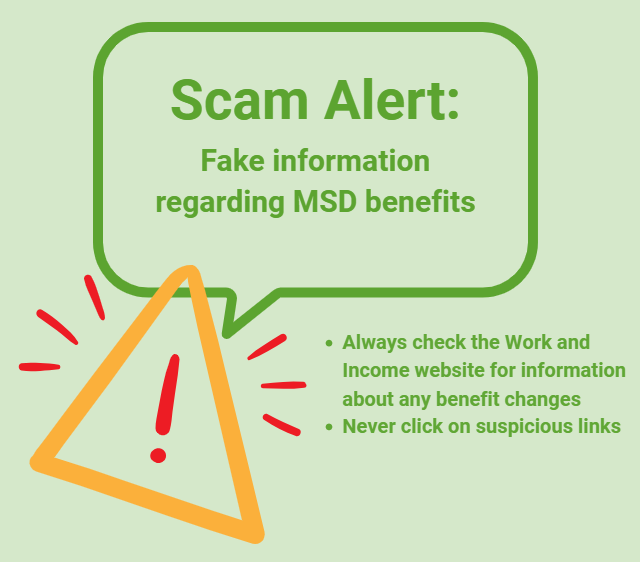
Scam Alert: Fake information regarding December Bonuses from MSD
The Ministry of Social Development is reporting that fake information is circulating about new ‘December bonuses’ or ‘benefit increases’
If you get suspicious communication, please contact Netsafe.
 Loading…