






Mind Your Language
Kiwibank is doing away with cheques from 2020 despite the fact that Kiwis still write some 18 million cheques a year. The language used by Kiwibank CEO, Steve Jurkovich, to announce this major change is causing a great deal of concern and even offence among a segment of Kiwibank customers.
So, what can you do to get your PR and communications challenges right when announcing major organisational changes?
Steve Jurkovich may be correct when he describes cheques as "’sunset technology’ providing a ‘shrinking service’ requiring ‘outdated’ technology that is ‘coming to the end of its useful life’" . But this is potentially offensive language for the large proportion of cheque users who are elderly. Furthermore, many of these customers are extremely vulnerable and may already be dealing with discrimination, elder abuse and the challenges of isolation and lack of mobility.
Kiwibank proposes sending out ‘personal letters’ and providing ‘tech teas’ where cheque users can learn about modern technology at their local branch. That is of course assuming that elderly customers have a computer or Smartphone and that getting to their branch isn’t a problem and that their community still has a local branch.
Kiwibank risks alienating not just the elderly but their families who will be forced to find other ways to help elderly family members make those essential daily financial transactions. Here are some steps you can follow that will help smooth any transition.
First, successful PR requires you to think about what your decisions will mean for all affected parties. Put yourself in their shoes and if you don’t know how your customers or employees think or anything about their lives you need to find out before you make major changes.
CEO Steve Jurkovich asked his 70 something year old mother what she thought of Kiwibank cancelling cheques and she was fine about it. But a survey of one person (and that person being your proud mother ) does not make a solid base for good PR communications.
Secondly, if you’re still convinced the changes are necessary for the overall health of your organisation then you need to think about how you communicate the coming changes.
Put yourself in the affected parties’ shoes and ask yourself, how will they perceive my communication? Can I ease the communication with a better choice of wording? What other steps can I take to make the transition easier for them?
Kiwibank promotes itself as a community bank for Kiwis with the aim of helping them to financial independence. With its latest announcement Kiwibank risks alienating a large number of its more vulnerable customers. Such a poorly executed PR campaign could potentially spell cheque-mate for a brand that relies on its community friendly approach.


Today’s Mind-Bender is the Last of the Year! Can You Guess It Before Everyone Else? 🌟🎁🌲
I dance in the sky with green and gold, a spectacle few are lucky to behold; I’m best seen in the south, a celestial sight—what am I, lighting up the New Zealand night?
Do you think you know the answer? Simply 'Like' this post and we'll post the answer in the comments below at 2pm on the day!
Want to stop seeing these in your newsfeed? No worries! Simply head here and click once on the Following button.

Scamwatch: How to recognise, avoid and act against scams.
A scam or a fraud is any scheme designed to con you out of money or steal your personal information. If someone contacts you unexpectedly – whether over the phone, through the post, by email, on a website, in person or on social media – always consider the possibility that it may be a scam.
Scammers target lots of people, often for small amounts of money. They constantly evolve their approach making scams harder to spot. Most scams come from overseas, but they may pretend to be locally based — from a reputable company, bank, or government agency, or even from your friends on social media if your account has been hacked. It is very difficult to get your money back once it is sent overseas.
Scams hurt us all. You can protect yourself and others by learning how to spot scams, share what you see and report them.
Figure out if you are being scammed: Use these questions to help figure out if you have been targeted by a scammer.
Article compiled from information kindly supplied by ConsumerProtection.govt.nz
Q&A regarding Neighbourly data breach
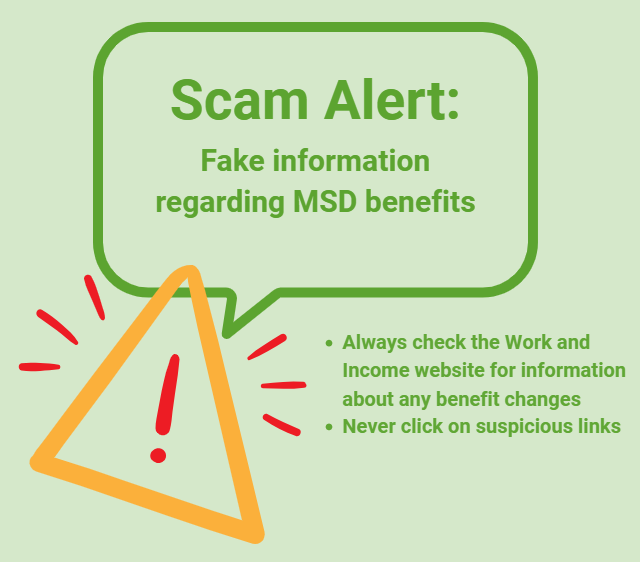
Scam Alert: Fake information regarding December Bonuses from MSD
The Ministry of Social Development is reporting that fake information is circulating about new ‘December bonuses’ or ‘benefit increases’
If you get suspicious communication, please contact Netsafe.
 Loading…