





Cashback websites – what you need to know
You may have seen them advertised and wondered if they’re too good to be true. Cashback websites such as Kiwi Wallet and Shopback promise to give you a percentage of your money back on online purchases.
Be careful though! The way cashback websites work can encourage us to spend more and miss out on better deals.
Here’s our guide to how cashback websites work and how to use them to benefit you.
How cashback websites work
========================
Juanita Neville-Te Rito is the managing director and founder of retail consultancy RX Group, so she often talks to businesses about whether they should be on these cashback platforms.
“Cashback websites work by acting as a middleman between retailers and shoppers. When a customer clicks on a retailer’s link through a cashback platform like ShopBack, the retailer pays the cashback site a commission for generating that sale,” Juanita explained. “Instead of keeping the entire commission, the cashback site shares a portion of it with the customer as a cashback reward.”
A cashback offer encourages customers to choose one brand over another. “For example, if I need a new pair of running shoes and I haven’t decided if they’re going to be Adidas or Nike or whatever, the offer of cashback might help you in your decision-making process.”
Retailers like the model because it’s performance-based – they only pay when a sale happens. “It’s a cost-effective alternative to traditional digital advertising where they pay for clicks or impressions with no guarantees of conversion,” Juanita said.
Some cashback offers can seem very generous – such as a 50% cashback. Which might have you wondering what the catch is.
But Juanita says retailers makes these big offers for two reasons – driving immediate sales and acquiring new customers.
“It’s tough and it’s tight out there so they’re using it as an incentive to get people to shop with them sooner rather than later. It creates an urgency, that fear of missing out. For instance, if you’re thinking about buying groceries, a cashback might convince you to do your shop today rather than waiting until later in the week,” she said.
“Retailers also use cashback to attract new shoppers. They have targeting capabilities to allow brands to reach users who shop in a particular category but haven’t purchased from them before.”
Shopback users can also play games to earn rewards, which Juanita said was about keeping users engaged when they’re not shopping.
“There’s only so much people can spend, so by introducing games it creates a new way for users to engage with the platform even when they’re not shopping. If members are regularly using the app they’re also more likely to see and take advantage of cashback offers,” she said.
“I think it’s quite a clever tactic because as consumers we’re getting used to gamification of our shopping. Temu has probably set the standard in how you can use it to get people shopping more often.”
Juanita says being on cashback websites was a cost that retailers were willing to pay at the moment, but she’s interested to see what happens if the economy improves.
“A good comparison was when people started using buy now pay later and retailers had to have every buy now pay later option. There was a steep cost to that and then we saw consolidation occur, partly because it was an unsustainable cost proposition for the retailer,” says Juanita.
“I think we’ll probably see the survival of the fittest in this market. Over time when the world gets a little stronger economically that’s when retailers might start to say, ‘I don’t need to do this anymore’.”
What’s the downside of cashback websites?
====================================
Bodo Lang, a professor of marketing analytics at Massey University, said cashback websites were simply a digital version of a marketing technique that goes back to the 1880s.
“Getting something for free or getting something special tends to result in greater sales. These techniques still work extremely well in 2025,” Bodo says.
“Cashback providers have pros and cons. The two key advantages are the opportunity to save money, typically between 1% and 10% of the value of a product, and the relative ease of use of these websites. However, there are disadvantages too. For example, cashback payments can be delayed, and there may be privacy concerns about what cashback providers do with customer data.”
Bodo said some people could also get lured into a cycle of spending more to save more.
“At a broader level, cashback websites are also a sign of the times – how markets become less transparent, and consumers can get caught up in a web of marketing, particularly online, thus consuming more of their time with shopping.”
Instead of using cashback websites, he said consumers could try negotiating with retailers.
“Instead of going through a cashback provider, consumers can approach retailers directly and ask for an equivalent discount that they may have received through a cashback provider. This leaves the retailer better off because they did not have to provide the additional discount to the cashback provider,” Bodo says.
5 things to know about using cashback websites
========================================
It can take a long time to get your hands on the money
Don’t imagine your cashback coming straight back to your account once you’ve confirmed your order – sometimes it can take months before you can claim it. And it can be even longer if you're booking accommodation as you usually have to wait a few months after you’ve taken the trip.
Offers can be capped
==================
You might be excited to see a big cashback offer, only to find the amount you can get back is limited. For example, I’m looking at a 25% cashback offer at Dominos on Shopback’s website that’s capped at $10.
You should really read the terms and conditions for each offer
No one wants to read the fine print, but it’s a good idea with cashback websites. There are often conditions that’ll mean you don’t get any cash back. For example, I can see Hello Fresh offering 100% cashback on Shopback, but in the fine print it says you can’t be renewing an old subscription.
Remember to go back and check it’s been logged
You need to visit the cashback website and then click through to the store’s website for your purchase to be tracked. Make sure you get an email confirmation or go back to the cashback website to make sure it has been tracked in its system.
Promo codes can void the cashback
Using a promo code when you’re on the retailer’s website can sometimes void the cashback. However, you might decide you’re better off using the promo than getting the cashback. Just don’t expect to be able to double up.
===================================================


Some Choice News!
Many New Zealand gardens aren’t seeing as many monarch butterflies fluttering around their swan plants and flower beds these days — the hungry Asian paper wasp has been taking its toll.
Thanks to people like Alan Baldick, who’s made it his mission to protect the monarch, his neighbours still get to enjoy these beautiful butterflies in their own backyards.
Thinking about planting something to invite more butterflies, bees, and birds into your garden?
Thanks for your mahi, Alan! We hope this brings a smile!


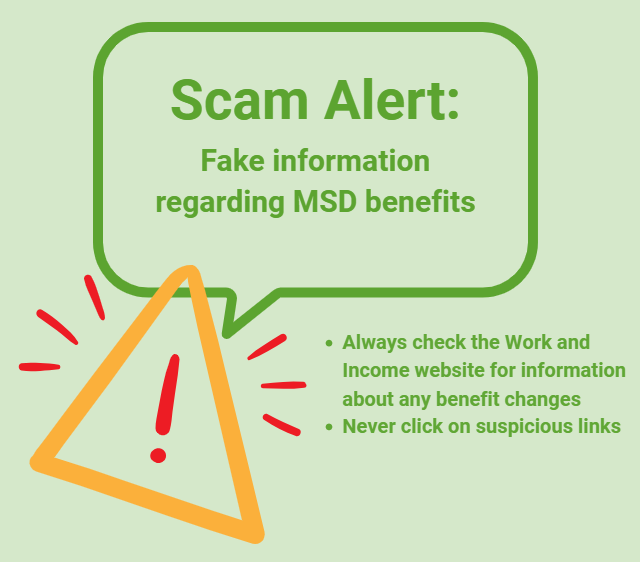
Scam Alert: Fake information regarding December Bonuses from MSD
The Ministry of Social Development is reporting that fake information is circulating about new ‘December bonuses’ or ‘benefit increases’
If you get suspicious communication, please contact Netsafe.
More than 120,000 disabled and older New Zealanders registered in the Total Mobility scheme will pay more for discounted taxi trips from next year as the Government announces a cut to trip subsidies.
Transport Minister Chris Bishop said subsidies would drop from 75% to 65% from July 1, 2026, blaming unsustainable rising costs.
Regional fare caps will also be lowered by around 10%.
Wide-ranging Ministry of Transport proposals for the scheme were released for consultation today. Suggested options included "strengthened" eligibility; periodic reassessments; caps on monthly trips; and the potential inclusion of ridesharing services.
"The Government is announcing decisions to stabilise the Total Mobility scheme so that the disability community is supported in a financially sustainable way, by all funding partners," Bishop said of the confirmed subsidy changes.
Disability Issues Minister Louise Upston said the new subsidy level would still be higher than what it was four years ago, when it was raised under the previous government.
"We appreciate these decisions will mean fares will increase for Total Mobility users.
"But they will still receive a higher subsidy level than prior to 2022. The changes also provide certainty that those who need the service will have continued access to it."
Demand for the scheme has soared since the subsidy rose from 50% in 2022. Registered users have jumped from 108,000 to 120,000, while trips have risen from 1.8 million in 2018 to three million.
Bishop said the 2022 increase had not accounted for higher demand over time.
"Increased demand now means the scheme is close to exceeding its Crown funding and is placing significant pressure on the contributions from local councils and NZTA," he said.
Costs are forecast to exceed funding by $236 million between 2025 and 2030 under current settings, according to the Government.
The Total Mobility scheme provided subsidised taxi fares for people who could not use public transport independently due to disability or age. The scheme was funded jointly by central government, NZTA's National Land Transport Fund and local councils.
The Government would also provide $10 million to NZTA to ease funding pressures on public transport authorities until the changes took effect.
Reacting to the subsidy changes, Disabled Persons Assembly chief executive Mojo Mathers told 1News that Total Mobility was an "essential service for us".
"This cut to Total Mobility on top of a cost-of-living crisis will only aggravate hardship in an already struggling population," she said in a statement.
"Total Mobility is an essential service for us. Not everyone can get on a bus or drive a car.
"Disabled people will face impossible choices when it comes to travel, when we know that over half don’t have enough to meet their everyday needs."
Labour has criticised the subsidy changes, saying the Government was "making life harder and more expensive for disabled New Zealanders".
Today's announcement came after a delayed year-long Transport Ministry review of the Total Mobility scheme, which included an earlier round of public consultation.
Further changes on the way, proposals in consultation
============================================
Alongside the subsidy cut, the Ministry of Transport has opened consultation on proposals including trip caps, stricter eligibility assessments, and expanding service providers beyond taxis to include ride-hail apps and on-demand public transport.
"Beyond ensuring the scheme’s financial viability, the Government is also taking the opportunity to consider changes to strengthen a system so that it works better for disabled people,” Upston said.
"The Ministry of Transport will be releasing a discussion document to consult on proposals to strengthen Total Mobility to ensure fairer, consistent and more sustainable access to services for people with the greatest need."
The wide-ranging proposals were not yet Government policy and were open for feedback until March 22, 2026. The 10% subsidy cut was not part of the consultation.
The proposals include trip caps, with two options. The first would give all users a flat monthly cap of 30 to 40 trips at 65% subsidy, with either no further subsidised trips or a reduced 50% subsidy once reached. The second would allocate 10 base trips, plus extras based on need – for example, for employment, health, or education.
The ministry proposed tighter eligibility requirements, including medical evidence from health practitioners, occupational therapists or psychologists when applying.
Currently, assessment standards varied, with no documentary evidence required.
Periodic reassessments would also be introduced under another proposal, requiring users to be re-evaluated after a set period to ensure they remained eligible.
The proposals also aimed to expand service providers beyond traditional taxis to include ride-hail apps, on-demand public transport services, and volunteer community transport providers. The ministry said this could increase availability and give users more options.
It was unclear whether ride-hailing apps would include popular ride-sharing apps such as Uber.
To improve wheelchair accessibility, the ministry also proposed more incentives for service providers, including higher funding for installing ramps and hoists in vehicles, and raising the $10 per wheelchair trip payment that has remained unchanged since 2005.
The ministry was also exploring a national public transport concession for people with disabilities – separate from Total Mobility and implemented through the National Ticketing Solution from 2027.
Labour critical of subsidy changes
============================
Labour disability issues spokesperson Priyanca Radhakrishnan said the Government was "making life harder and more expensive for disabled New Zealanders by slashing discounted transport fares during a cost-of-living crisis".
"Under Christopher Luxon, disabled Kiwis will now pay more just to get to work, attend health appointments, or see loved ones,” she said in a statement.
"Disability communities feel betrayed. First came the overnight cut to flexible funding; then restrictions on residential care with no warning.
"Then Whaikaha was gutted and disability support shifted to the Social Development Ministry. Now, the transport subsidy many rely on to live independently has been cut.
"For many disabled Kiwis, affordable transport isn’t a nice-to-have, it’s a lifeline. It means independence, dignity, and the ability to participate in everyday life and that’s why Labour increased the subsidy in government. This latest change is taking us backwards."
=========================================================
 Loading…