





A bulk of some of society’s most important workers - from doctors, nurses, teachers, prison staff and other healthcare personnel - will walk off the job next Thursday in a mega industrial strike tipped to be the largest in New Zealand in recent history.
An estimated 100,000 workers from the public sector - also including dentists, social workers, physiotherapists and mental health staffers - are set to be involved, as they take a stand for better pay and conditions, as well as raising concerns around safe staffing levels.
Public Service Minister Judith Collins, meanwhile, has released an open letter to anyone who will be impacted by the strikes and said they appeared to be “politically motivated by the unions”.
Who is striking?
=============
About 17,000 health members with the Public Service Association are taking part in the strike on October 23.
They are made up of allied health staff, mental and public health nurses, home support workers and policy, knowledge, advisory and specialist workers who want fair pay, safe staffing and improved conditions to give what they say is quality care patients deserve.
Why are they striking?
==================
PSA national secretary Fleur Fitzsimons said its members were standing up for safe staffing and for the public health service.
“We have been heartened by the overwhelming support from the public for the strikes, and we know that the protests on the day will be an expression of solidarity between workers in health, education ... and the public they serve.
“These workers have not taken strike action lightly, but consider they have a responsibility to stand up for the health service they know New Zealanders need.”
Health NZ’s pay offers have been criticised by senior doctors, with the PSA describing a 2 per cent rise, followed by a 1.5 per cent increase over a 30-month period as being well below inflation.
“The pay offers are effectively pay cuts during a cost-of-living crisis. We risk losing more health workers to Australia,” the PSA said.
There are not enough health workers to provide the level of care Kiwis need and, to make up numbers, staff were often having to pull double shifts.
“They can’t give their best to patients when they’re so thinly stretched and burnt out.”
The NZ Educational Institute has confirmed more than 40,000 of its members will strike for extra classroom support for children with diverse learning needs.
More than 20,000 unionised secondary and area school teachers are also involved in the mega strike due to a lack of progress with collective agreement negotiations, the Post-Primary Teachers’ Association confirmed earlier this month.
A 1% pay rise offer from the Government, in August, had also served as a trigger; dubbed by the PPTA as “appalling” and the lowest increase in a generation.
Underpaid and understaffed, workers ‘infuriated’
=======================================
NZ Council of Trade Unions president Richard Wagstaff said the strike action was in response to a centralised government strategy to hold down wages below inflation and to cut resources to the public service.
He said the wide range of professional workers had been negotiating for more than a year, in some cases. The only response they had received, he said, was from employers wanting them to be locked into a long-term agreement with pay adjustments under inflation.
“And they’ve given them no proper response to the resource issues - the short staffing, the breaking down of equipment and so on.
“They know that by cutting wages and by basically having people overworked and underpaid, it really risks the workforce dissipating and leaving for better places, particularly Australia.”
Wagstaff said it was unfair and “quite infuriating” for workers, given that the Government has said it would address the cost-of-living crisis.
“And here they are telling their own workers - their essential workers who keep everything running - that they should expect a pay cut.”
Wagstaff called on ordinary members of the public to get out on Thursday and strike with workers to show their support.
He said they were fighting not just for themselves, but for all Kiwis.
“It’s these public services that enable all of us to live decent lives - health services we can rely on, education services so we can reach our potential, public services to keep us protected and support our interests as a community.
“They are standing up for quality public services.
“They are really exasperated by employers who seem intent on reducing the public sector, reducing the wages of the public sector, reducing the services of the public sector and reducing the resources.”
Public Service Minister’s open letter to affected Kiwis
===========================================
Collins has written an open letter to patients, students and families affected by this week’s planned strike.
“The Government regrets the impact on you, your children and your families that is expected on Thursday because of a strike planned by a number of unions.
“We regret even more that the strike appears to be politically motivated by the unions. What else could possibly explain that in early October, when we were trying to negotiate with the secondary teachers’ union, the number one item on their agenda for a meeting with Education Minister Erica Stanford was Palestine,” Collins wrote.
“Palestine. Not terms and conditions. Not student achievement. Not the new curriculum. Palestine. That’s now what students or parents should expect.”
Collins urged parents of senior students to ask their children’s teachers to question their union’s priorities.
“And to all the parents of younger children, who have had to rearrange their usual commitments, I urge you to ask your children’s teachers why their union arranged a strike in a week when many schools already have teacher-only days, followed by Labour Day on Monday.”
Collins went on to say that the Government has acted in good faith and met with unions’ demands for pay increases in line with inflation.
She also spoke directly to those Kiwis who have had medical appointments and procedures postponed due to the strike.
“I know some of you are living in pain and in fear of a possible diagnosis that will now be delayed. This industrial action is unfair and unwarranted.”
Collins said they value nurses, doctors and other health workers whose everyday care supports patients. They also valued teachers, principals and teacher aides, she said.
“We value all public sector employees.”
The Government had a responsibility to manage the country’s finances carefully - and especially when “money is tight”, she said.
“From cancer drugs to social housing, from support for vulnerable people to conversation initiatives, there are thousands of appeals for increased spending as well as for wage increases.
“The country is simply not earning enough to meet all these calls.”
She pointed to a “huge increase” in public spending over Covid and in the following years, which resulted to public debt exploding.
“It is only unions who want strikes. We ask, once again, for them to come to the table. That is the place to talk and to bargain.”
======================================================

Some Choice News!
Many New Zealand gardens aren’t seeing as many monarch butterflies fluttering around their swan plants and flower beds these days — the hungry Asian paper wasp has been taking its toll.
Thanks to people like Alan Baldick, who’s made it his mission to protect the monarch, his neighbours still get to enjoy these beautiful butterflies in their own backyards.
Thinking about planting something to invite more butterflies, bees, and birds into your garden?
Thanks for your mahi, Alan! We hope this brings a smile!


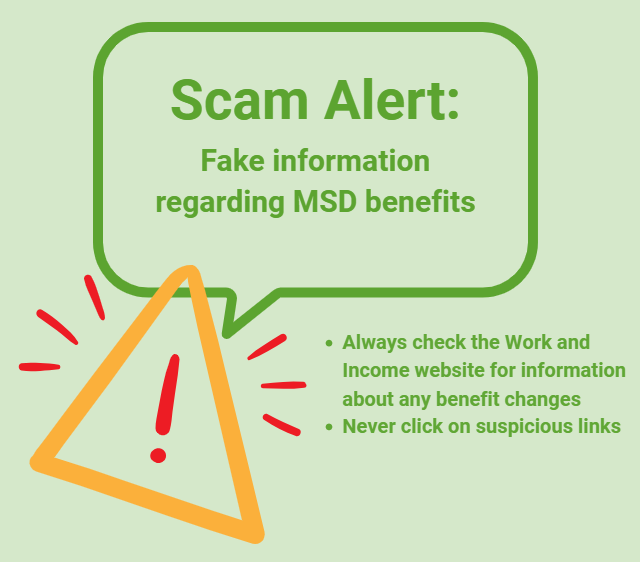
Scam Alert: Fake information regarding December Bonuses from MSD
The Ministry of Social Development is reporting that fake information is circulating about new ‘December bonuses’ or ‘benefit increases’
If you get suspicious communication, please contact Netsafe.
More than 120,000 disabled and older New Zealanders registered in the Total Mobility scheme will pay more for discounted taxi trips from next year as the Government announces a cut to trip subsidies.
Transport Minister Chris Bishop said subsidies would drop from 75% to 65% from July 1, 2026, blaming unsustainable rising costs.
Regional fare caps will also be lowered by around 10%.
Wide-ranging Ministry of Transport proposals for the scheme were released for consultation today. Suggested options included "strengthened" eligibility; periodic reassessments; caps on monthly trips; and the potential inclusion of ridesharing services.
"The Government is announcing decisions to stabilise the Total Mobility scheme so that the disability community is supported in a financially sustainable way, by all funding partners," Bishop said of the confirmed subsidy changes.
Disability Issues Minister Louise Upston said the new subsidy level would still be higher than what it was four years ago, when it was raised under the previous government.
"We appreciate these decisions will mean fares will increase for Total Mobility users.
"But they will still receive a higher subsidy level than prior to 2022. The changes also provide certainty that those who need the service will have continued access to it."
Demand for the scheme has soared since the subsidy rose from 50% in 2022. Registered users have jumped from 108,000 to 120,000, while trips have risen from 1.8 million in 2018 to three million.
Bishop said the 2022 increase had not accounted for higher demand over time.
"Increased demand now means the scheme is close to exceeding its Crown funding and is placing significant pressure on the contributions from local councils and NZTA," he said.
Costs are forecast to exceed funding by $236 million between 2025 and 2030 under current settings, according to the Government.
The Total Mobility scheme provided subsidised taxi fares for people who could not use public transport independently due to disability or age. The scheme was funded jointly by central government, NZTA's National Land Transport Fund and local councils.
The Government would also provide $10 million to NZTA to ease funding pressures on public transport authorities until the changes took effect.
Reacting to the subsidy changes, Disabled Persons Assembly chief executive Mojo Mathers told 1News that Total Mobility was an "essential service for us".
"This cut to Total Mobility on top of a cost-of-living crisis will only aggravate hardship in an already struggling population," she said in a statement.
"Total Mobility is an essential service for us. Not everyone can get on a bus or drive a car.
"Disabled people will face impossible choices when it comes to travel, when we know that over half don’t have enough to meet their everyday needs."
Labour has criticised the subsidy changes, saying the Government was "making life harder and more expensive for disabled New Zealanders".
Today's announcement came after a delayed year-long Transport Ministry review of the Total Mobility scheme, which included an earlier round of public consultation.
Further changes on the way, proposals in consultation
============================================
Alongside the subsidy cut, the Ministry of Transport has opened consultation on proposals including trip caps, stricter eligibility assessments, and expanding service providers beyond taxis to include ride-hail apps and on-demand public transport.
"Beyond ensuring the scheme’s financial viability, the Government is also taking the opportunity to consider changes to strengthen a system so that it works better for disabled people,” Upston said.
"The Ministry of Transport will be releasing a discussion document to consult on proposals to strengthen Total Mobility to ensure fairer, consistent and more sustainable access to services for people with the greatest need."
The wide-ranging proposals were not yet Government policy and were open for feedback until March 22, 2026. The 10% subsidy cut was not part of the consultation.
The proposals include trip caps, with two options. The first would give all users a flat monthly cap of 30 to 40 trips at 65% subsidy, with either no further subsidised trips or a reduced 50% subsidy once reached. The second would allocate 10 base trips, plus extras based on need – for example, for employment, health, or education.
The ministry proposed tighter eligibility requirements, including medical evidence from health practitioners, occupational therapists or psychologists when applying.
Currently, assessment standards varied, with no documentary evidence required.
Periodic reassessments would also be introduced under another proposal, requiring users to be re-evaluated after a set period to ensure they remained eligible.
The proposals also aimed to expand service providers beyond traditional taxis to include ride-hail apps, on-demand public transport services, and volunteer community transport providers. The ministry said this could increase availability and give users more options.
It was unclear whether ride-hailing apps would include popular ride-sharing apps such as Uber.
To improve wheelchair accessibility, the ministry also proposed more incentives for service providers, including higher funding for installing ramps and hoists in vehicles, and raising the $10 per wheelchair trip payment that has remained unchanged since 2005.
The ministry was also exploring a national public transport concession for people with disabilities – separate from Total Mobility and implemented through the National Ticketing Solution from 2027.
Labour critical of subsidy changes
============================
Labour disability issues spokesperson Priyanca Radhakrishnan said the Government was "making life harder and more expensive for disabled New Zealanders by slashing discounted transport fares during a cost-of-living crisis".
"Under Christopher Luxon, disabled Kiwis will now pay more just to get to work, attend health appointments, or see loved ones,” she said in a statement.
"Disability communities feel betrayed. First came the overnight cut to flexible funding; then restrictions on residential care with no warning.
"Then Whaikaha was gutted and disability support shifted to the Social Development Ministry. Now, the transport subsidy many rely on to live independently has been cut.
"For many disabled Kiwis, affordable transport isn’t a nice-to-have, it’s a lifeline. It means independence, dignity, and the ability to participate in everyday life and that’s why Labour increased the subsidy in government. This latest change is taking us backwards."
=========================================================
 Loading…