





🌺 Stories of early Wadestown
🐎 Were there stables in Hanover Street?
Tracing the origins of old stories about a place is not easy! When we were writing the story about the old farmhouse at 27 Hanover Street, we were intrigued by a question about stables that were said to have existed “next door”.
🐎 The “Fernhill” stables
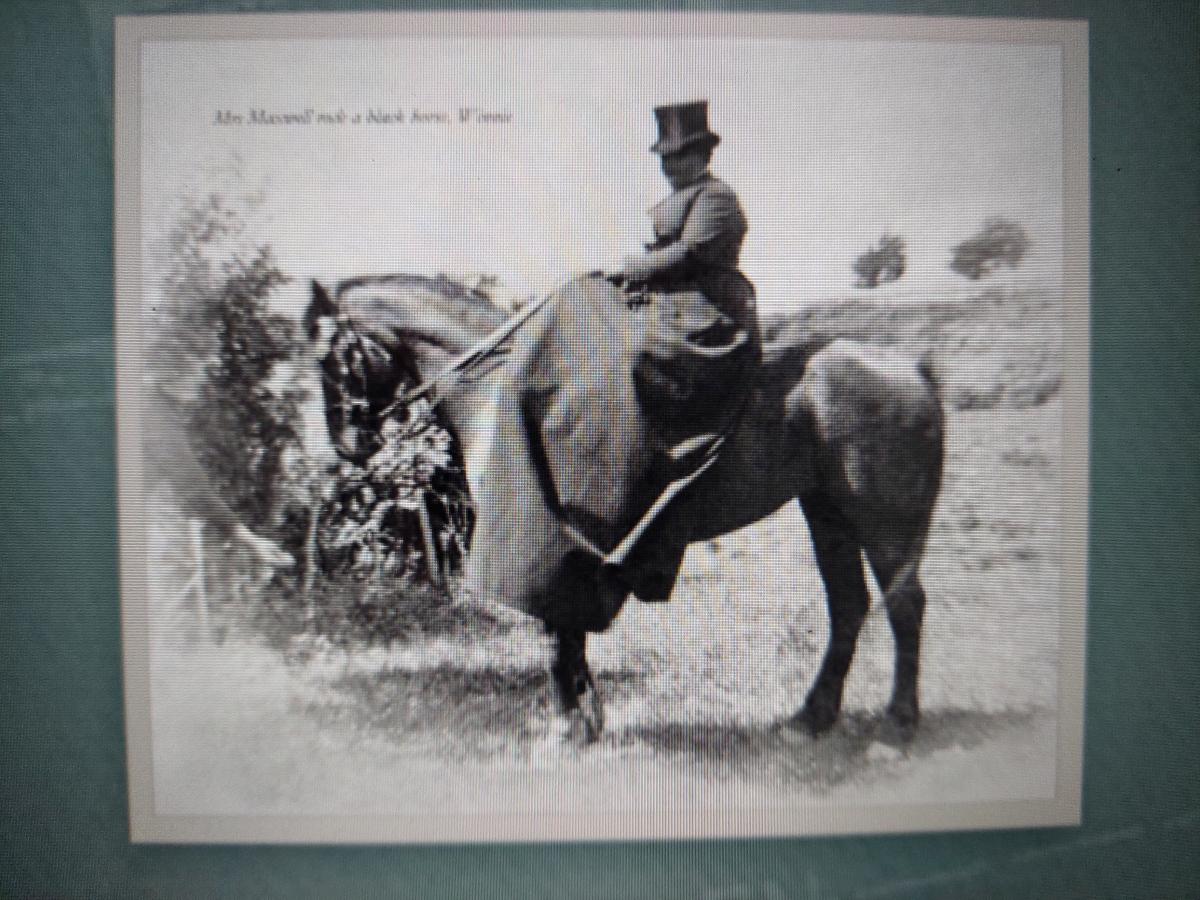
Horses were the transport of necessity in very early Wadestown. In the 1860s to 1880s, Euphemia Maxwell, the owner and school mistress at “Fernhill” (Wadestown’s oldest house, at 15 Fernhill Terrace – watch out for our upcoming April posting!), famously used to get about on her black horse, Winnie! When I was talking with Tina Matthews who grew up in “Fernhill”, she mentioned early stories about horses being grazed in the paddocks between Fernhill Terrace and Hanover Street. “Fernhill” itself had stables that were swallowed up in the Fernhill subdivision in the late 1880s/early 1890s. The subdivision created housing sections on the lower part of Pitt Street, and the “Fernhill” stables were on one of these sections. But Tina couldn’t remember any stables in lower Hanover Street when she was growing up.
🐎 The stables at the top of the street
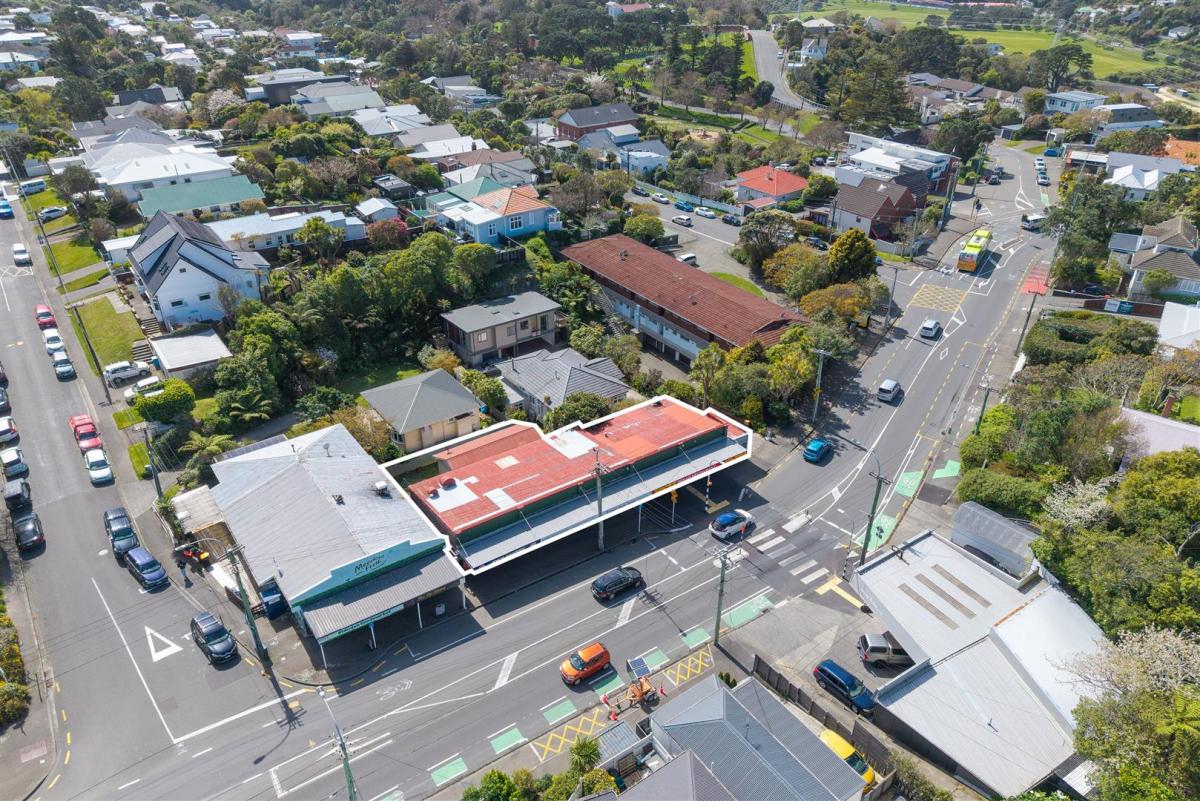
There were also stables and a bakery behind the store that opened at the corner of Hanover Street and 114 Main Road Wadestown from about 1880 (from 1915/16 until 1932 this was Plummer’s Grocer and Baker). But the old farmhouse is at the bottom of Hanover Street, not the top. So being very fond of detective stories, we kept looking for evidence of “the stables next door” …
🐎 The stable down Trelissick track
When James Hooper sold 3 acres of his dairy farm in 1878 to another dairyman, John Nash, the farmhouse at 27 Hanover Street was part of it, but there was no mention of horses (or stables).
In 1896, Nash sold the 3 acres to John Holmes, who bought it in trust for his daughter, Mrs Henrietta (Nettie) Ashworth. We know from Bronwyn Shrapnell’s notes in the Onslow Historian in 1973 that Nettie’s husband Henry Ashworth, a carrier, “kept his horse in a stable about 12 yards down the Trelissick track”. Where exactly was that stable? There is no evidence of such a building on or near the Trelissick Track as it now stands. Perhaps it was where the (1960s) cottage at 25 Hanover Street now stands, at the head of the Track, next door and to the north of 27 Hanover Street…
🐎 "The Nash farmhouse that stood next door”
There is another possibility. In the Onslow Historian, Bronwyn Shrapnell said “the Nash farmhouse … stood next door, [to 27 Hanover Street] until it was destroyed by fire a few years ago.” Bronwyn’s notes said that the Nash farmhouse received extensive fire damage and was pulled down, and that the barn/hayloft was blown off its foundations during the Wahine storm [10 April 1968]. [The hayloft also featured in a 1919 news report of a home invasion of Mr George Nash, Hanover Street. The person concerned fled, and was found “hiding in the hayloft”.] We felt that we were on the right track… a barn and hayloft… so maybe horses and stables?
Further search revealed that while the Ashworths were living at 27 Hanover Street (1896 to 1944), Mr George Nash built a dwelling with stables and dairy next door, at 31 Hanover Street [there is no #29]. The plans were approved in 1905, and George Nash lived there until his death at 72 years old in 1945 (a year after the Ashworth family had sold 27 Hanover Street). In his obituary, it says that George Nash “was for many years a suburban dairy farmer with a large milk delivery service over the greater part of Wellington North.” The George Nash Milk Distributing Company operated from premises in Molesworth Street.
🐎 Mystery solved: there were stables in Hanover Street at the Nash Farmhouse, 31 Hanover Street, from 1905.
🌺 But solving one mystery throws up so many other intriguing questions:
- What relation was George Nash to “John Nash, dairyman”, owner of 27 Hanover Street, next door, from 1878 until 1896?
- Did the 3 acres that John Nash bought in 1878 include both 27 and 31 Hanover Street?
- Where did George Nash graze his dairy herd (as a “suburban dairy farmer”)? Did he also rent or own the dairy farm that Hooper had owned from 1858?
- Did the Nash family continue living at “the Nash farmhouse” after 1945, until destroyed by storm and fire, in the late 1960s? Is that why it was still known as the Nash Farmhouse?
- Did the stables outlast the fire and the Wahine storm, to finally succumb to the section-clearing that preceded the building of flats in 1970? If so, were they still used as stables, in that age of the family car?
- Was George related to the other Nash residents in Hanover Street: W Nash, who was on the first Wadestown School Committee in 1881; W W Nash (another dairyman) who was living in Hanover Street in 1917; or Pvt W R Nash who served in WW1 before coming back to his mother’s home at 35 Hanover Street?
- The bakery at the top of Hanover Street survived a fire in 1920. Were Plummer’s stables still operating then? What is the next chapter in their story?
🌺 If you can shed some light on these questions, add a post to our Neighbourly page! 🌺

Today’s Mind-Bender is the Last of the Year! Can You Guess It Before Everyone Else? 🌟🎁🌲
I dance in the sky with green and gold, a spectacle few are lucky to behold; I’m best seen in the south, a celestial sight—what am I, lighting up the New Zealand night?
Do you think you know the answer? Simply 'Like' this post and we'll post the answer in the comments below at 2pm on the day!
Want to stop seeing these in your newsfeed? No worries! Simply head here and click once on the Following button.


No gift? No stress
Let the Christmas elves at Mags4gifts.co.nz handle your last-minute shopping. For a limited time, gift a subscription with up to 40% off best-sellers like TV Guide, NZ House & Garden, and NZ Gardener. It’s the perfect Christmas present, sorted in minutes (and no one needs to know it was a last-minute surprise)!


Poll: Is it ok to regift something that you have been given?
🎁 Holiday Gift Chat!
Do you ever regift?
What’s your take on asking for a receipt if a gift doesn’t fit?

-
79.3% Yes! It's better to regift what I don't need
-
20.7% No. It's the thought and effort that matters
 Loading…