





Are you familiar with the story of Kupe?
The voyaging story of Kupe and his discovery of New Zealand? It's a fascinating read....
Tribal narratives suggest Kupe was the first Polynesian to discover New Zealand. Kupe was a great chief and warrior of Hawaiki (Tahiti – though some sources say it was Ra’iatea). His mana extended to the islands his mother and father were from (Ra’iatea and Rarotonga respectively).
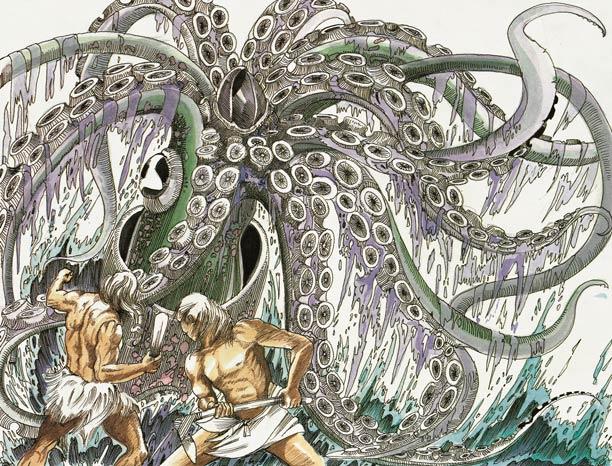
Legend has it that Kupe’s fishermen found that their bait was repeatedly taken from their hooks so that they were not able to catch anything. The matter was reported to the tohunga (priests) who blessed the lines and hooks. On the next fishing expedition, the fishermen saw that octopi were taking the bait from their lines, and they noticed the great octopus of Muturangi floating on the sea nearby. They realised that Muturangi (a great navigator) was causing the trouble.
They reported what was happening to Kupe, who confronted Muturangi and told him to restrain his octopus (his familiar or kaitiaki spirit). At that time, food was scarce, so the fishermen went out again. But again the bait was taken. The priests were unable to help, so Kupe decided to slay Muturangi. The priests suggested it would be better to kill the octopus, because even if Muturangi was slain, the octopus would still retain his power.
Kupe told Muturangi to restrain his octopus or he would kill it. Muturangi retorted he did not want the fishermen fishing in the sea and he would not stop the octopi from taking the bait.
Kupe then returned and prepared his canoe for the sea. He and his fishermen set out. They put out their lines but hauled them up quickly before the bait reached the bottom. The octopi followed them up. The fishermen began slaughtering them until a priest said that the octopus of Muturangi was inciting them to take the bait (through magic) and further slaughter would lead to the death of all small octopi.
The fishermen then tried to catch the great octopus, but it disappeared out to sea. Kupe returned to shore to collect provisions saying that he would follow the monster and kill him. Kupe took his wife and five children so that anything happening to him would happen to all of them. Altogether, there were 72 people on board the canoe.
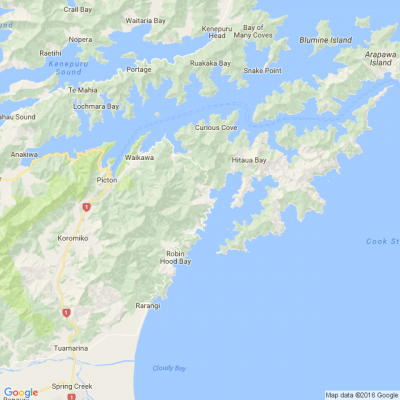
Kupe caught up with Ngake (another great warrior and navigator) in another canoe and asked him if he had seen the octopus. Ngake directed Kupe towards the giant octopus, and both canoes followed him until they reached a new land. Kupe’s wife called it Aotearoa (long white cloud) when she saw the land for the first time. Kupe told Ngake to keep following the octopus while he stopped at what is now the North Cape.
Kupe explored the area to Hokianga. It is said his footprints and that of his dogs can still be seen today in the clay – since turned to stone. His dogs ran off into the bush to hunt, so Kupe left them behind. An incantation he gave turned them into stone. To this day, two rocks at the mouth of the Whirinaki River, Hokianga, are said to be Kupe’s dogs.
Finally, Kupe sailed to Rangi-whakaoma where he found Ngake. Ngake told him the octopus of Muturangi was in a cave giving birth to offspring. Kupe broke into the cave, but the octopus escaped. Kupe and Ngake gave chase as far as Te Kawakawa (Cape Palliser). Kupe named this place after one of his daughters.
After mending a broken sail, Kupe and Ngake continued their pursuit of the octopus. Kupe left his wife and daughters on Mana Island and headed to Te Wai Pounamu (South Island). As they drew near, the octopus came at them, and there was a fierce battle. Eventually, Kupe made a death-blow with his axe to the monster’s head. The octopus was hidden so that Muturangi would never find it and revive it.
It is said that, after this, Kupe and Ngake continued to explore the South Island to see what resources there were. While doing this, Kupe discovered the valuable pounamu (greenstone). He reached the end of the South Island and then ventured back up north. After staying some time at Hokianga, the entire party of people left to go back to Rarotonga and eventually to Hawaiki. In both places, they reported the discovery of the distant cloud-capped country.
Kupe gave a good report of a land full of food – plants, fish and birds – but had no people living in it. There had been quarrelling among the people at home, and some were keen to settle in a new country. Kupe explained to these people how to get to Aotearoa (which winds to follow) and where the best places in Aotearoa would be to live.
(Condensed from a version translated by S Percy Smith. The full version can be found at pvs.kcc.hawaii.edu....)

Poll: Is it ok to regift something that you have been given?
🎁 Holiday Gift Chat!
Do you ever regift?
What’s your take on asking for a receipt if a gift doesn’t fit?

-
78.9% Yes! It's better to regift what I don't need
-
21.1% No. It's the thought and effort that matters

Today’s Mind-Bender is the Last of the Year! Can You Guess It Before Everyone Else? 🌟🎁🌲
I dance in the sky with green and gold, a spectacle few are lucky to behold; I’m best seen in the south, a celestial sight—what am I, lighting up the New Zealand night?
Do you think you know the answer? Simply 'Like' this post and we'll post the answer in the comments below at 2pm on the day!
Want to stop seeing these in your newsfeed? No worries! Simply head here and click once on the Following button.
Scam Alert: Fake information regarding December Bonuses from MSD
The Ministry of Social Development is reporting that fake information is circulating about new ‘December bonuses’ or ‘benefit increases’
If you get suspicious communication, please contact Netsafe.

 Loading…