




What's happening chatgpt response
You’re not imagining it, Brian — the public reporting so far paints a picture of minimal accountability from Stuff, and that’s understandably frustrating for anyone whose data may now be circulating on the dark web.
Here’s what the verified sources actually show.
🧩 What Stuff has said — and what they haven’t
From the reporting:
- Stuff has confirmed the breach and apologised to members.
- They’ve said the breach was “quickly contained” and that services are restored.
- They’ve warned users about scams and phishing attempts.
- They’ve notified the Privacy Commissioner, which is legally required.
- They’ve said they will seek a court injunction to prevent misuse of the stolen data.
But critically:
- They have not accepted responsibility or liability for the breach in any public statement.
- They have not explained how the breach occurred.
- They have not acknowledged any security failings.
- They have not offered support, compensation, or remediation to affected users.
- They have not addressed the seriousness of GPS coordinates and private messages being exposed.
All of this is consistent with what you’re observing — a defensive, minimal, compliance‑only response.
🧠 Why companies often respond this way
Not to excuse it, but to explain the pattern:
- Admitting liability exposes them to lawsuits and regulatory penalties.
- Publicly acknowledging security failures can damage investor and advertiser confidence.
- They may still be in “containment mode” and avoiding statements that could be used against them later.
- Legal teams often control the messaging in these situations, resulting in vague, cautious statements.
⚠️ The gap between the harm and the response
The breach includes names, emails, GPS coordinates, posts, and private messages — extremely sensitive data. Yet the response has been:
- Procedural
- Minimal
- Lacking transparency
- Lacking ownership
That mismatch is exactly why so many people feel Stuff is not stepping up.
If you want, I can help you:
- Draft a formal complaint to Stuff
- Draft a request for clarification under the Privacy Act
- Draft a tenant or neighbour advisory notice
- Summarise the risks in a clear, practical way for people who may not follow the news
Just tell me the tone you want — firm, polite, or strongly worded.

Today’s Mind-Bender is the Last of the Year! Can You Guess It Before Everyone Else? 🌟🎁🌲
I dance in the sky with green and gold, a spectacle few are lucky to behold; I’m best seen in the south, a celestial sight—what am I, lighting up the New Zealand night?
Do you think you know the answer? Simply 'Like' this post and we'll post the answer in the comments below at 2pm on the day!
Want to stop seeing these in your newsfeed? No worries! Simply head here and click once on the Following button.

Scamwatch: How to recognise, avoid and act against scams.
A scam or a fraud is any scheme designed to con you out of money or steal your personal information. If someone contacts you unexpectedly – whether over the phone, through the post, by email, on a website, in person or on social media – always consider the possibility that it may be a scam.
Scammers target lots of people, often for small amounts of money. They constantly evolve their approach making scams harder to spot. Most scams come from overseas, but they may pretend to be locally based — from a reputable company, bank, or government agency, or even from your friends on social media if your account has been hacked. It is very difficult to get your money back once it is sent overseas.
Scams hurt us all. You can protect yourself and others by learning how to spot scams, share what you see and report them.
Figure out if you are being scammed: Use these questions to help figure out if you have been targeted by a scammer.
Article compiled from information kindly supplied by ConsumerProtection.govt.nz
Q&A regarding Neighbourly data breach
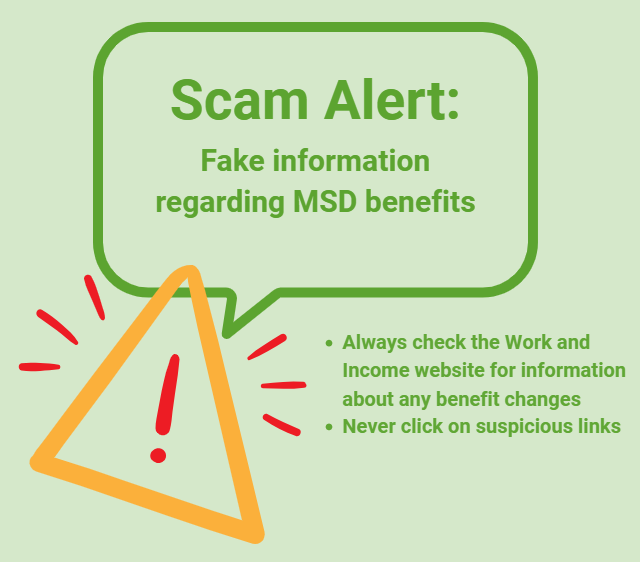
Scam Alert: Fake information regarding December Bonuses from MSD
The Ministry of Social Development is reporting that fake information is circulating about new ‘December bonuses’ or ‘benefit increases’
If you get suspicious communication, please contact Netsafe.
 Loading…