





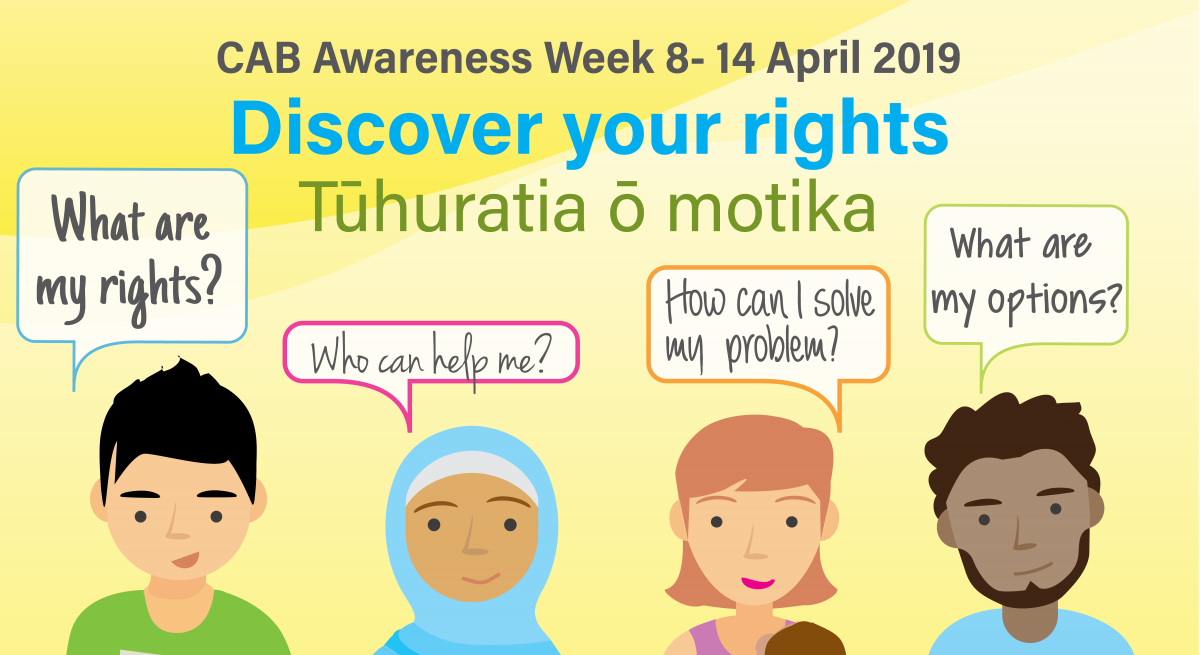
Discover your rights with the CAB!
Do you know what your rights are at work? How about your rights to do with renting or owning a home? If you buy something that’s faulty do you know what your options are? This CAB Awareness Week from 8-14 April you’re being invited to Discover Your Rights – Tūhuratia ō motika!
Helping people to know what their rights and responsibilities are and how they can act on these is core to what the Citizens Advice Bureau is about. We help people from all walks of life to access the information they need so they are empowered to take next steps and to resolve their problems.
A highlight of this year’s Awareness Week is the launch of the CAB’s new public website - www.cab.org.nz.... After a year of development and user testing, the resulting website provides an accessible, mobile-friendly, knowledgebase of 2,000 questions and answers about people’s rights that are based on real issues confronted by clients.
The information about rights is grounded in the law but is practical and is expressed in a way that’s easy to understand.
The website also provides a directory of more than 30,000 community organisations so that the CAB can help connect people with any additional services they need.
We’re keen to break down any barriers people face in finding out what their rights are. Our new website is a fantastic resource for the whole community, and complements the amazing face-to-face and phone service provided by our skilled and dedicated volunteers.
We invite you to Discover Your Rights with us this Awareness Week by checking out our new website www.cab.org.nz..., calling us 0800 367 222, or by visiting your local CAB. We’re here to help.

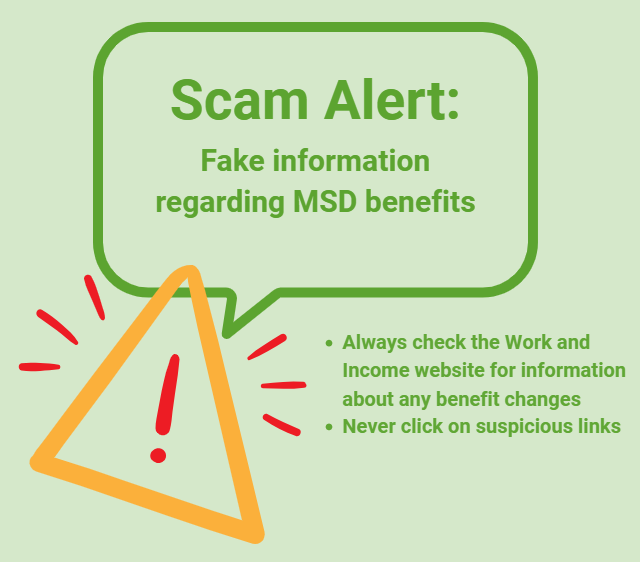
Scam Alert: Fake information regarding December Bonuses from MSD
The Ministry of Social Development is reporting that fake information is circulating about new ‘December bonuses’ or ‘benefit increases’
If you get suspicious communication, please contact Netsafe.
Poll: Are Kiwis allergic to “exuberance”? 🥝
In The Post’s opinion piece on the developments set to open across Aotearoa in 2026, John Coop suggests that, as a nation, we’re “allergic to exuberance.”
We want to know: Are we really allergic to showing our excitement?
Is it time to lean into a more optimistic view of the place we call home? As big projects take shape and new opportunities emerge, perhaps it’s worth asking whether a little more confidence (and enthusiasm!) could do us some good.

-
41.3% Yes
-
32.8% Maybe?
-
25.9% No

Police urge caution on Southland beaches
As the weather warms up and Southlanders begin flocking to the beach, Police are reminding people of an important fact – beaches are roads and need to be treated as such.
Senior Sergeant Scott MacKenzie, Southland Area Road Policing Manager, says while it is legal to drive on Oreti Beach, you still need to adhere to the road rules.
“The beach has a speed limit of 30k/h – there is no excuse to be over this limit.
The days are getting warmer and with school holidays it can be expected that a lot of families with small children and animals will be heading to the beach to enjoy the sun."
“Anyone driving on the beach needs to be mindful of this, and stay focused on your surroundings,” he says.
The risks of injury or worse, to yourself or others, are just the same as on traditional roads.
Senior Sergeant MacKenzie also reminds beach goers that any form of antisocial road-user behaviour will not be tolerated.
“Some people seem to think that road rules don’t apply to you when on the beach – this is not the case.
Antisocial driving behaviour is unacceptable, on and off the beach, and we encourage the community to report the driving behaviour immediately."
“It is best to make a report while the incident is occurring to allow our staff the opportunity to respond immediately and hopefully disrupt any offenders in the act.
Please take note of as much detail as possible, such as registration number of the vehicle, any identifying features of the vehicle and its driver, or even take a video of the driving behaviour if safe to do so,” he says.
You can report information to us by calling 111 if it is happening now, or through 105 for non-emergencies.
Alternatively, you can report information anonymously through Crime Stoppers on 0800 555 111.
 Loading…