





Good you buy must be of "acceptable quality"
If you buy consumer goods from a New Zealand business, you are protected by law. The Consumer Guarantees Act says that those goods must be of “acceptable quality” under the law. But what does this actually mean?
Basically it means that anything you buy from a business should do what you would expect it to, and last a reasonable length of time.
Under the Consumer Guarantees Act (CGA) a product is of acceptable quality if it:
is fit for its normal purpose (eg a vacuum cleaner should clean the floor well),
is in good working order (eg a vacuum cleaner should work reliably),
has an acceptable finish and appearance (eg a new vacuum cleaner should not have dents or scratches),
has no minor defects (eg a vacuum cleaner hose should be securely attached not loose),
is safe to use (eg a vacuum cleaner should not overheat) and
is durable (eg a vacuum cleaner should last a reasonable amount of time before breaking down).
If you arrange for the business to deliver the product to you, they are responsible for ensuring that it arrives in good working order.
You do need to take into consideration the age and price of the item. For example, you would not expect a very cheap item to last as long as a more expensive version; and you might expect to see some wear and tear on a secondhand item but not on a brand new one.
Another thing to remember is that if the business points out any faults with an item before you buy it, you can’t claim for those faults later.
If the goods are not of acceptable quality, you can go back to the business as soon as you find a problem with it and they have to do something to put it right. Keep a record of problems you have had with it, such as when it has inexplicably stopped working, and receipts for any repairs you’ve had to get done to it.
Depending on what the problem is, the business must:
repair it at no cost to you, or
replace the item or give you a refund if it can’t easily be fixed.
The business can’t simply refer you to the manufacturer, require you to return the item in its original packaging, or offer you store credit instead of a refund. Don’t be put off if the warranty has expired - if you reasonably expect something to last several years, then you can go back to the business if there’s a problem with it.
If the product is faulty and caused damage to your property, you may be entitled to compensation for that.
If you do strike any problems getting the problem fixed just give your local CAB a call or visit.
For more information, visit our Consumer Guarantees Act and Fair Trading Act page or the Consumer Protection page on faulty products.

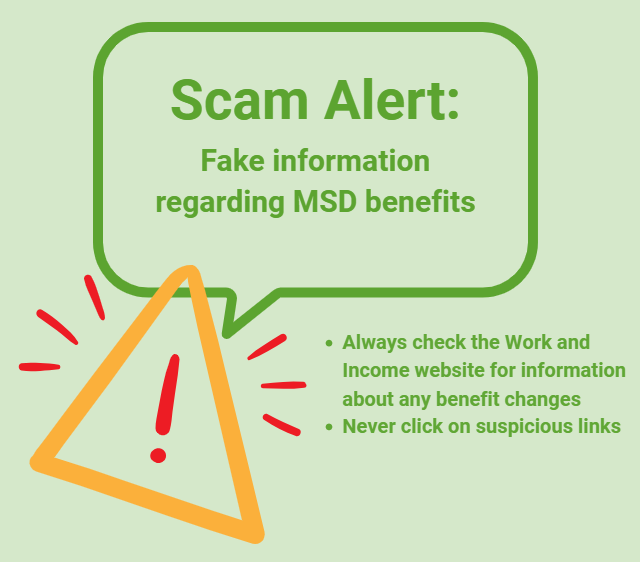
Scam Alert: Fake information regarding December Bonuses from MSD
The Ministry of Social Development is reporting that fake information is circulating about new ‘December bonuses’ or ‘benefit increases’
If you get suspicious communication, please contact Netsafe.
Poll: Do you set New Year’s resolutions?
🎉 2026 is almost here!
We’re curious ... how do you welcome it?
Do you set resolutions, follow special traditions, or just go with the flow?
-
10% Yes! New Year, New Me
-
16.9% Yes - but I rarely stick to them
-
73.2% Nah - not for me
Update to Neighbourly members on data breach 06/01/2025 8am
Yesterday in the High Court at Auckland, Neighbourly was successful in being granted an injunction against any unauthorised use of the data taken in a recent breach.
As we alerted you on January 1 and confirmed on January 3, our systems were accessed illegally and members’ information, including names, email addresses, GPS coordinates from the address you provided to us, forum posts and direct member communications were among the data that was accessed.
We acted immediately upon hearing of a potential breach: we temporarily disabled the site, notified members and authorities and worked with our external security consultants to understand if and how it had occurred. We then confirmed the breach with members, safely restored the site to service and began the process of seeking the injunction. Yesterday’s decision by Justice Johnstone prohibits the use of the data by any unauthorised person, and requires them to permanently delete it, or any information obtained from it.
This does not mean that vigilance against scammers is not still required: there is a large industry globally that seeks to use stolen information for identity fraud or to dupe people into providing details of their financial affairs for theft. Again, to keep yourself safe from scammers it is critical that you:
- Don’t click links in emails. Instead, type the web address directly into your browser. This helps ensure you’re visiting a real site, not a fake one
- Enable two-factor authentication where available as this adds an extra layer of security to your data
- Stay alert for phishing emails. Be cautious of unexpected emails asking for personal information, especially ones that create a sense of urgency.
Again, we want to apologise to you for this illegal access to the Neighbourly database and to assure you that we have carefully worked through how this occurred. We have safely secured the site and its services for use and ensured we have robust processes in place so this cannot happen again.
We are continuing to work with the relevant authorities, including the National Cyber Security Centre, on any further steps we need to take.
If you have any further questions please contact us via our customer support team at helpdesk@neighbourly.co.nz.
 Loading…