





Ashburton’s second bridge cost bumped up
By local democracy reporter Jonathan Leask:
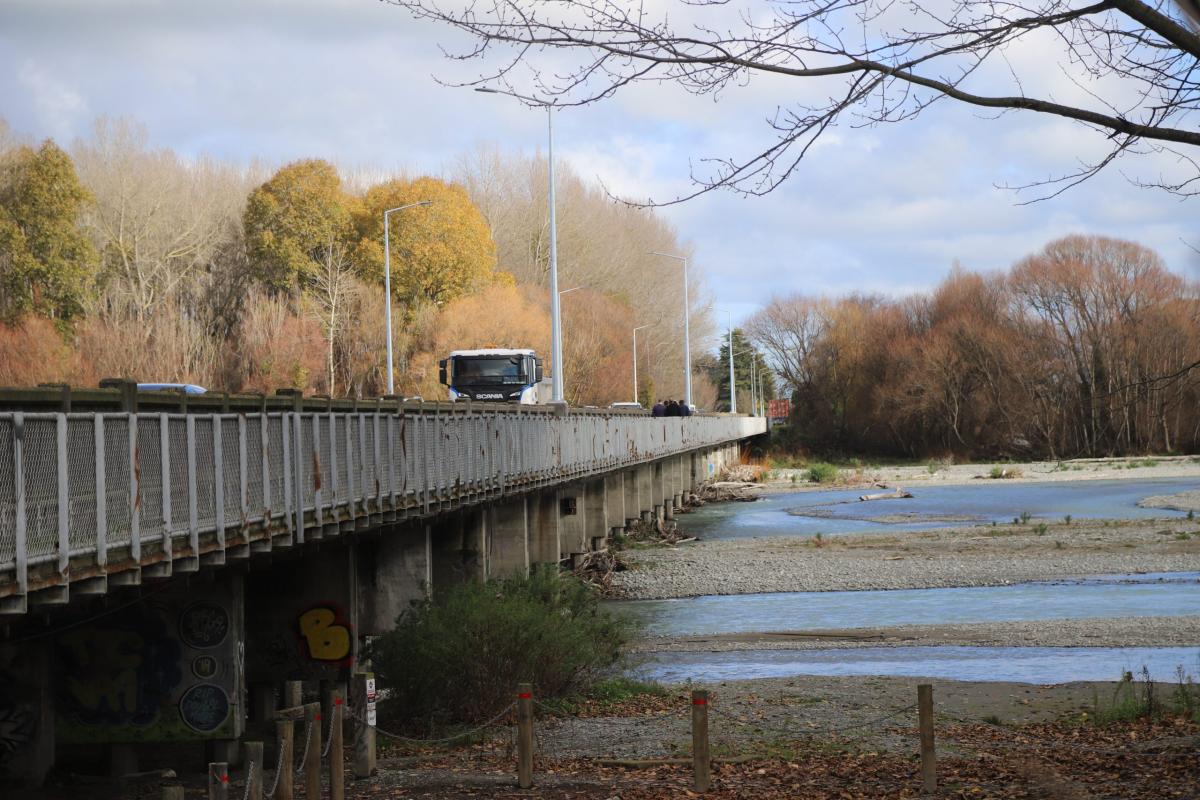
The cost to build Ashburton’s second bridge has leapt to $130 million as questions remain on how it will be funded.
The council has kept its contribution at $7.5m, despite the estimated price jumping by 15% in two years.
Ashburton Council chief executive Hamish Riach provided councillors with an update on the second bridge after he recently met with Minister of Transport Simeon Brown.
The Government has made the bridge, a key State Highway 1 route in Canterbury, a national transport priority.
Minister Brown made it clear that the council would need to look for funding in the National Land Transport programme process, Riach said.
That will start with conversations between the council and NZ Transport Agency Waka Kotahi around “innovative funding mechanisms”.
After meeting, Riach and Mayor Neil Brown reached out to NZTA regional relationships director James Caygill about “actively getting on with those conversations with their funding people”.
The National Land Transport programme is an investment package for priority transport projects.
For a project to be included in the National Land Transport Programme it has to feature in a council’s long-term plan, Riach said.
The council has chosen to keep the $7.5m figure in its budget planning, even though the cost of the project has increased.
The business case prepared in 2022 estimated the project – a 360m-long bridge across the Ashburton/Hakatere River and new road infrastructure - would cost $113m.
An NZTA document prepared in November estimated the project will cost between $100-$200m.
A recent report from Infometrics, commissioned by Local Government New Zealand, found that over the last three years, costs have gone up significantly and bridges are 38% more expensive to build.
“We note the bridge is programmed to cost $130m and our share, at $7.5m, may or may not survive the whole funding process.
“A lot is going on in this space that is incredibly uncertain.”
The council will adopt its LTP in June – including the $7.5m figure – before knowing what the NLTP entails, Riach said.
“It makes for a messy picture for this project in our formal plans and budgets.”
The minister acknowledged the need for the bridge - easing congestion and improving safety on SH1 - and as a result, the subsidy rate “needed to reflect the improvement to the state highway network”, Riach said.
“We took from that, that a subsidy rate ahead of our normal FAR (funding assistance rate) was entirely justified.”
Rather than a 51% FAR subsidy the business case suggested a 62%, but the question remains how to fill the gap between 62% and 100%, Riach said.
Mayor Brown said the minister also spoke of the Government looking at different ways of funding roading going forward.
This included the possibility of road tolls, Riach said.
“He reiterated that it is certainly his intention to review the way in which tolling is a mechanism for funding projects a little bit later in the year.”
***************************************************
No tolls without law change
Under legislation, tolls can only be placed on state highways, not on a local road, which is what the second bridge is considered to be.
It also prevents an NZTA toll from raising funds for a council project – so a toll on the existing SH1 bridge couldn’t be used to fund the new local road bridge.
A legislative change could see the possibility of introducing a toll on the existing SH1 Ashburton/Hakatere Bridge or on the second bridge to pay for the project.
There are currently only three toll roads in New Zealand – the Northern Gateway Toll Road north of Auckland, the Tauranga Eastern Link Toll Road, and the Takitimu Drive Toll Road, both in Tauranga.

The Summer Kiwi Quiz is back by popular demand
Grab a copy of your local Stuff newspaper between 1 Jan - 28 Jan and participate in the Summer Kiwi Quiz! Test your knowledge, answer the daily New Zealand based questions, and find out how well you know our beautiful country!
Each correct answer will get you one entry into the draw to WIN 1 of 5 Ooni Karu 2 Portable Pizza Oven bundles, valued at $1024! Each bundle includes: an Ooni Karu 2 Multi-Fuel Portable Pizza Oven, Ooni Karu 2 Carry Cover, Ooni 12" Perforated Peel, Ooni Digital Infrared Thermometer and an Ooni Cookbook: Cooking with Ooni. The more answers you enter correctly, the higher your chance of winning. For more information and to submit your answers, click here
The Team at Stuff


Poll: Do you set New Year’s resolutions?
🎉 2026 is almost here!
We’re curious ... how do you welcome it?
Do you set resolutions, follow special traditions, or just go with the flow?

-
10.4% Yes! New Year, New Me
-
19.9% Yes - but I rarely stick to them
-
69.7% Nah - not for me
Scam Alert: Fake information regarding December Bonuses from MSD
The Ministry of Social Development is reporting that fake information is circulating about new ‘December bonuses’ or ‘benefit increases’
If you get suspicious communication, please contact Netsafe.

 Loading…