






‘Affordable housing is a human right’: Deputy mayor suggests leasehold properties in Kaiapoi
By David Hill, Local Democracy Reporter
Affordable housing needs to be a priority for Kaiapoi as the town is the brink of major growth, Waimakariri deputy mayor Neville Atkinson says.
Atkinson is looking at ways to keep house prices down, including offering leasehold land for development.
More than a decade on from the 2010 and 2011 earthquakes which devastated the town, its population is now more than 13,000 and is set for more growth.
Atkinson, who is the council’s housing portfolio holder, said affordable housing is a human right, but the question is how to achieve it.
‘‘People are saying ‘you keep talking about it and don’t do anything’, but we are, but it is complicated and planning takes time.
‘‘There are so many people in different degrees of inadequate housing and there are no easy solutions.
‘‘It is about looking at different models which can work and giving people some options.’’
Statistics New Zealand high growth projections suggest the town could grow by 52% over the next 30 years, creating demand for an extra 2900 new houses.
The proposed Waimakariri District Plan, which is expected to take effect later this year, proposes opening up 97 hectares for housing in Kaiapoi - enough land for more than 4000 houses.
To help reduce the upfront housing costs and rising debt levels, Atkinson would like to see more council and government owned land opened up as leasehold land for housing.
‘‘There would need to be a bit of due diligence around the lease agreements, but it could be a great option for people.
‘‘As long as we can get banks on board, it would significantly reduce their mortgage as they wouldn’t need to borrow as much.’’
Te Kohaka o Tuhaitara Trust, a partnership between the council and Te Ngāi Tūāhuriri Rūnanga, has proposed making former red zone land at Kairaki Beach available as leasehold land for housing.
Atkinson said the land may only have finite life, given the predictions around sea level rise, so it would mean home owners were not tied to the land.
Another option could be selling a house on an undeveloped section, with the home owner adding a driveway, garage, lawn and garden as they could afford it.
‘‘It won’t work for everybody and developers often want to offer a complete package, but we need to look at ways of making it more affordable.’’
The council is expecting an update soon on a mixed used development on former red zone land on the south bank of the Kaiapoi River, first proposed by local developer William Hill Consulting Ltd in 2021.
Atkinson is also keen for his council to explore a Dunedin City Council model of centralised hot water heating cylinders on pensioner housing, which has significantly reduced power bills.
■ LDR is local body journalism co-funded by RNZ and NZ On Air.


Today’s Mind-Bender is the Last of the Year! Can You Guess It Before Everyone Else? 🌟🎁🌲
I dance in the sky with green and gold, a spectacle few are lucky to behold; I’m best seen in the south, a celestial sight—what am I, lighting up the New Zealand night?
Do you think you know the answer? Simply 'Like' this post and we'll post the answer in the comments below at 2pm on the day!
Want to stop seeing these in your newsfeed? No worries! Simply head here and click once on the Following button.


Scamwatch: How to recognise, avoid and act against scams.
A scam or a fraud is any scheme designed to con you out of money or steal your personal information. If someone contacts you unexpectedly – whether over the phone, through the post, by email, on a website, in person or on social media – always consider the possibility that it may be a scam.
Scammers target lots of people, often for small amounts of money. They constantly evolve their approach making scams harder to spot. Most scams come from overseas, but they may pretend to be locally based — from a reputable company, bank, or government agency, or even from your friends on social media if your account has been hacked. It is very difficult to get your money back once it is sent overseas.
Scams hurt us all. You can protect yourself and others by learning how to spot scams, share what you see and report them.
Figure out if you are being scammed: Use these questions to help figure out if you have been targeted by a scammer.
Article compiled from information kindly supplied by ConsumerProtection.govt.nz
Q&A regarding Neighbourly data breach
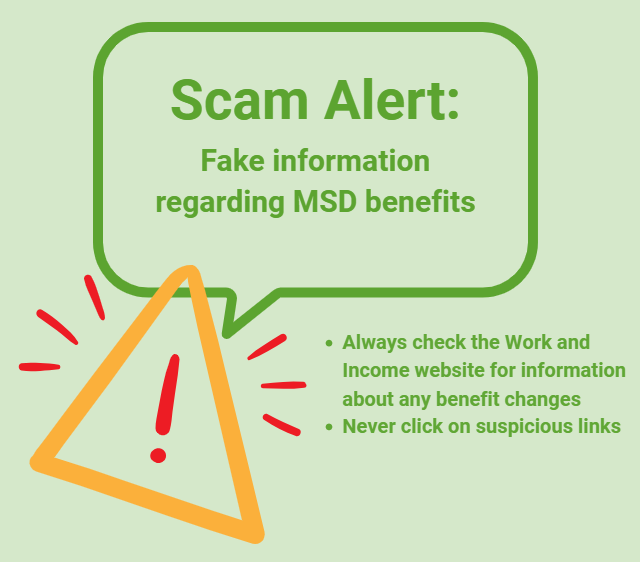
Scam Alert: Fake information regarding December Bonuses from MSD
The Ministry of Social Development is reporting that fake information is circulating about new ‘December bonuses’ or ‘benefit increases’
If you get suspicious communication, please contact Netsafe.
 Loading…