





Dunedin: absolutely positively (almost) the gaming capital of New Zealand
From reporter Hamish McNeilly:
Dunedin has leapfrogged Christchurch and Wellington to move to second place in New Zealand for gaming studios.
The southern city now had 19 gaming studios, behind Auckland (27), but well ahead of Wellington (13) and Christchurch (5), according to a 2022 New Zealand Game Developers Association survey.
The secret to Dunedin’s success was the establishment of the government-backed New Zealand Centre of Digital Excellence (Code).
When Code was set-up in 2019, Dunedin only had four gaming studios in the city: Runaway, Rocketwerkz (which has since relocated), Spotted Kiwi Interactive and Balancing Monkey Games, a report presented to the economic development committee of the Dunedin City Council on Monday morning.
As a result of Code funding, 25 studios had been set up – of which some had been disbanded and staff absorbed into other studios.
The committee heard that Code funding, which included grants for studios and support to attend gaming conferences, had contributed to 90 jobs.
‘’Dunedin has become a destination for game development studios,’’ the report said.
That included an Auckland-based company choosing the city for its satellite base, while other larger studios visiting the city for ‘’scouting purposes’’.
Another example was Deep Field Games established by successful United States’ indie developer, Geoff Keene, who ‘’chose Dunedin over any other city in New Zealand, and New Zealand over any other city in the world to set up his new studio’’, the report noted.
The studio’s nine staff members, which included some laid-off from Rocketwerkz, had secured oversea’s investment and a publishing commitment, with the first game expected to be launched in September.
The report also noted that Māori representation, 8%, was almost three times higher than the national average, 3%.
Code chief executive Tim Ponting told the committee that the studios and their staff enjoyed being based in Dunedin, and there was loyalty between them and Code.
‘’We are building an ecosystem here.’’
The Government announced it was increasing its support to $2.25million a year, until 2027 to expand Code, which wil remain headquartered in Dunedin but have an expanded national focus.
‘’New Zealand’s game development sector has been rapidly growing,’’ Minister for the Digital Economy and Communications, David Clark said of the November announcement.
The latest data from the New Zealand Game Developers Association shows the total revenue for the industry was $407m, compared to $276m a year ago.
Code’s new focus would see the team expand from four roles to seven, with representatives to be added for Auckland and Wellington.


Today’s Mind-Bender is the Last of the Year! Can You Guess It Before Everyone Else? 🌟🎁🌲
I dance in the sky with green and gold, a spectacle few are lucky to behold; I’m best seen in the south, a celestial sight—what am I, lighting up the New Zealand night?
Do you think you know the answer? Simply 'Like' this post and we'll post the answer in the comments below at 2pm on the day!
Want to stop seeing these in your newsfeed? No worries! Simply head here and click once on the Following button.

Scamwatch: How to recognise, avoid and act against scams.
A scam or a fraud is any scheme designed to con you out of money or steal your personal information. If someone contacts you unexpectedly – whether over the phone, through the post, by email, on a website, in person or on social media – always consider the possibility that it may be a scam.
Scammers target lots of people, often for small amounts of money. They constantly evolve their approach making scams harder to spot. Most scams come from overseas, but they may pretend to be locally based — from a reputable company, bank, or government agency, or even from your friends on social media if your account has been hacked. It is very difficult to get your money back once it is sent overseas.
Scams hurt us all. You can protect yourself and others by learning how to spot scams, share what you see and report them.
Figure out if you are being scammed: Use these questions to help figure out if you have been targeted by a scammer.
Article compiled from information kindly supplied by ConsumerProtection.govt.nz
Q&A regarding Neighbourly data breach
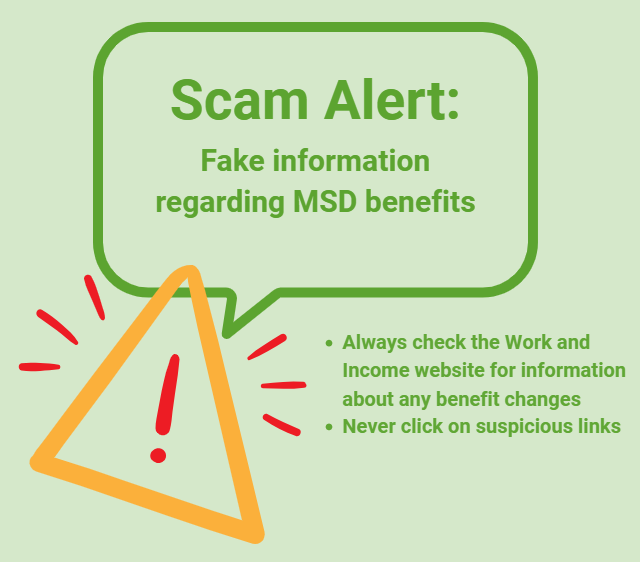
Scam Alert: Fake information regarding December Bonuses from MSD
The Ministry of Social Development is reporting that fake information is circulating about new ‘December bonuses’ or ‘benefit increases’
If you get suspicious communication, please contact Netsafe.
 Loading…