





From field to felt: uncovering the story of the Anzac Poppy
Every year without fail, the red blooms appear on politicians' jackets and in street appeals - but have you ever wondered where they came from?
For many younger New Zealanders, the poppy could seem to be a symbol of Anzac pride. However, it had little to do with the Anzacs at first, but was rather originally conceived for an American audience.
The symbol of the poppy itself comes from Lieutenant Colonel John McCrae's famous WW1 poem 'In Flanders fields', which begins with the opening lines: "In Flanders fields the poppies blow, between the crosses row on row".
It was these moving verses which inspired American war secretary Moina Michael to use red silk poppies as a symbol of remembrance.
After campaigning for two years to get the symbol recognised nationally, the poppy was adopted by the National American Legion as their official symbol at a conference in 1920.
Attending this conference was Frenchwoman Anna A Guérin, who saw the potential to sell poppies and put the proceeds towards caring for veterans, their families and poor children. She also had the foresight to take it beyond America to Canada, the UK, Australia and New Zealand.
After her representative Colonel Alfred Moffatt suggested the idea to the RSA in September 1921, a motion was passed and the RSA placed the first order for poppies.
Like the other countries, the RSA was planning to hold its first annual Poppy Appeal around Armistice Day (November 11): however, thanks to the French ship carrying the poppies arriving late, the decision was made to delay sales until Anzac Day, 1922.
The first Poppy Appeal was a huge success, birthing the tradition where poppies go on sale in the weeks before Anzac Day and thus tying them to the day forever.
While the poppies were originally sourced from France, the RSA began producing its own in 1931, which were made by former servicemen in Auckland and Christchurch. Production was to go offshore again in 2010: however, this proved controversial and the contract eventually returned to Christchurch for the period from 2014 to 2019.
As poppies reappear this year, take a moment to remember their long journey and how they help the very organisation caring for our soldiers.
Yet more importantly, like the generations before us moved by McCrae's poem, remember those Flanders fields and what the symbol truly stands for - to never forget.
Story by Jordan Gowan
Thanks to this local business:
Staples Rodway Limited

Today’s Mind-Bender is the Last of the Year! Can You Guess It Before Everyone Else? 🌟🎁🌲
I dance in the sky with green and gold, a spectacle few are lucky to behold; I’m best seen in the south, a celestial sight—what am I, lighting up the New Zealand night?
Do you think you know the answer? Simply 'Like' this post and we'll post the answer in the comments below at 2pm on the day!
Want to stop seeing these in your newsfeed? No worries! Simply head here and click once on the Following button.

Scamwatch: How to recognise, avoid and act against scams.
A scam or a fraud is any scheme designed to con you out of money or steal your personal information. If someone contacts you unexpectedly – whether over the phone, through the post, by email, on a website, in person or on social media – always consider the possibility that it may be a scam.
Scammers target lots of people, often for small amounts of money. They constantly evolve their approach making scams harder to spot. Most scams come from overseas, but they may pretend to be locally based — from a reputable company, bank, or government agency, or even from your friends on social media if your account has been hacked. It is very difficult to get your money back once it is sent overseas.
Scams hurt us all. You can protect yourself and others by learning how to spot scams, share what you see and report them.
Figure out if you are being scammed: Use these questions to help figure out if you have been targeted by a scammer.
Article compiled from information kindly supplied by ConsumerProtection.govt.nz
Q&A regarding Neighbourly data breach
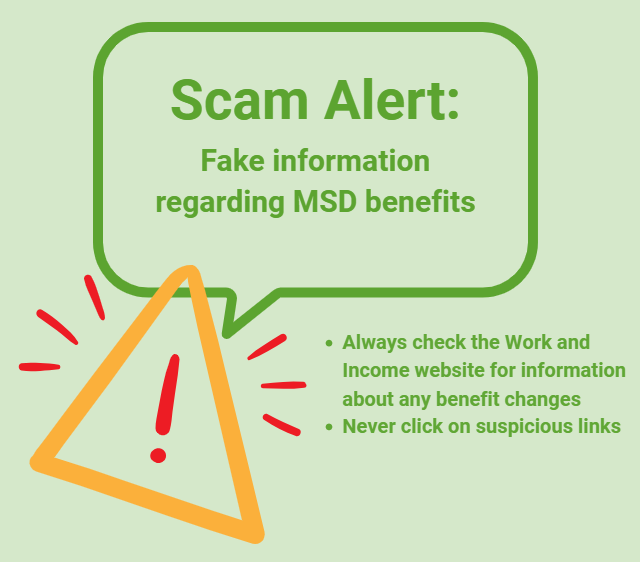
Scam Alert: Fake information regarding December Bonuses from MSD
The Ministry of Social Development is reporting that fake information is circulating about new ‘December bonuses’ or ‘benefit increases’
If you get suspicious communication, please contact Netsafe.
 Loading…